

Quote of the day by Elon Musk: “When something is important enough, you do it even if the odds are not in your favor” – a lesson on conviction, risk and pursuing goals worth the uncertainty | World News


Quote of the day by Elon Musk: "When something is important enough, you do it even if the odds are not in your favor" - a lesson on conviction, risk and pursuing goals worth the uncertainty
Quote of the day by Elon Musk (AP photo)

Success tends to look inevitable once it has already happened, the finished company, the working invention, the achievement everyone now takes for granted. What usually gets left out is the genuine uncertainty that came before any of it. Elon Musk described exactly that uncertainty in one plain sentence. “When something is important enough, you do it even if the odds are not in your favor,” he said. The quote is not really about taking risks for their own sake. It is about deciding what actually matters enough to pursue despite real uncertainty, a decision he made himself before founding a company with genuinely long odds of ever working out.

Quote of the day by Elon Musk

“When something is important enough, you do it even if the odds are not in your favor”

Where this quote actually comes from

Musk said this in a 2012 interview with Scott Pelley on 60 Minutes, discussing his decision to found SpaceX despite having no background in rockets whatsoever. “The odds of me coming into the rocket business, not knowing anything about rockets, not having ever built anything,” he said, “I mean, I would have to be insane if I had thought the odds were in my favor.” He then added the line now quoted everywhere. “When something is important enough, you do it even if the odds are not in your favor.” SpaceX’s own early history backs up exactly how real those odds were. Its first three Falcon 1 rocket launches all failed, nearly bankrupting the company, before a fourth attempt finally succeeded in 2008.

What the quote is actually saying

The core message is that genuinely important goals are not always easy or safe to pursue. If something truly matters, there will be moments where the actual chances of success look genuinely uncertain, and continuing anyway requires real conviction. None of this is an argument for ignoring facts or taking reckless risks. It is simply recognising that low odds do not automatically mean a goal is impossible, and that meaningful achievement sometimes requires continuing to work even without any guarantee of success.

Why important goals so often involve real uncertainty

The biggest ambitions almost always involve genuine unknowns. Starting a business means competing in a market nobody can fully predict. Developing new technology means solving problems that may not have an obvious answer yet. If people wait until success is fully guaranteed before ever taking action, plenty of genuinely worthwhile opportunities simply never get pursued at all.

Why persistence matters most exactly when the odds are low

Difficult goals rarely produce quick results. There will usually be failed attempts, unexpected obstacles, and long stretches where progress seems to stall completely. Persistence is what lets someone keep learning from those experiences anyway, and each attempt tends to reveal a bit more about what actually works and what genuinely needs to change. Over time, that persistence can meaningfully improve the odds of something that initially looked unlikely.

Why preparation matters just as much as courage

Taking action despite difficult odds was never really about acting without any preparation at all. Courage tends to work best when it is backed by real knowledge and real planning, researching the options, understanding the actual risks, and preparing genuine alternatives for when something inevitably goes wrong. The goal was never eliminating uncertainty completely, since that is usually impossible anyway. It is becoming properly prepared to deal with it instead.

Why failure should not always be read as defeat

Failure genuinely hurts, but it also carries real information. A failed attempt can reveal a specific weakness in an idea or its execution, and people who actually learn from that failure tend to make their next attempt considerably stronger. This does not mean every failed project deserves to be pursued indefinitely. Sometimes failure is a perfectly legitimate reason to change direction entirely. The real skill is telling the difference between giving up simply because something is hard, and changing course because the actual evidence now points somewhere else.

Why genuine conviction makes a real difference

People tend to persist far longer when they genuinely believe in why their goal actually matters. That conviction provides real motivation during the stretches when outside reward is scarce, letting someone keep learning and experimenting even while others around them remain doubtful, which matters most precisely when an idea looks unusual or impractical to everyone else.

Why persistence and stubbornness are not the same thing

There is a real difference between determination and simply refusing to accept reality. Persistence means continuing to work toward a genuinely meaningful goal while still learning and adapting along the way. Stubbornness means continuing with exactly the same approach regardless of what the evidence actually shows. Successful persistence usually involves changing the method while keeping the larger goal firmly in view, and that flexibility can matter just as much as sheer determination.

Other famous quotes by Elon Musk

“Persistence is very important. You should not give up unless you are forced to give up.”“Failure is an option here. If things are not failing, you are not innovating enough.”“I think it is possible for ordinary people to choose to be extraordinary.”“I always invest my own money in the companies that I create. I don’t believe in the whole thing of just using other people’s money.”

What it means in today’s world

Not every worthwhile goal arrives with favourable odds attached to it. Sometimes there is genuinely no certainty the effort will actually succeed. What matters, in the end, is deciding whether the goal itself is important enough to justify the work, the preparation and the real risk involved. The lesson was never to blindly chase every unlikely possibility. It is to recognise the goals that genuinely matter, understand the actual risks clearly, and then decide honestly whether they are worth the effort required to reach them.

Source link

Meet Dennis Hope: The unemployed man who claimed the Moon, sold 611 million acres and made millions from $19.95 lunar plots |


Meet Dennis Hope: The unemployed man who claimed the Moon, sold 611 million acres and made millions from $19.95 lunar plots

For centuries, owning land has meant having a place that can be measured, divided and legally transferred. Dennis Hope thought he had found an exception. In the late 20th century, while considering how to make money from property, the unemployed American turned his attention away from land on Earth and towards the moon. He had read the 1967 United Nations Outer Space Treaty, which prevents countries from claiming celestial bodies as their territory. Hope believed the wording left an opening for a private individual. He declared the moon his property, divided it into parcels and began selling certificates to customers around the world. The idea attracted buyers, but it also raised a basic legal question: can anyone actually own a piece of the moon?

How an unemployed man turned the moon into a property idea

Hope’s story started when he was out of work and thinking about how he might make money from property. Real estate seemed familiar enough, but there was a problem: conventional land was already owned, divided and priced by somebody else. The moon presented a rather different possibility.During his university years, Hope had encountered the 1967 United Nations Outer Space Treaty. The agreement established that nations could not claim sovereignty over celestial bodies such as the moon. Hope interpreted the wording as leaving room for a private individual to make a claim.He eventually sent a declaration to the United Nations stating that he intended to claim the moon, divide it into parcels and sell them. He expected that the organisation might respond with a legal objection. According to Hope, no answer arrived.

The legal challenge behind Hope’s claim to the moonz

The Outer Space Treaty does not simply say that governments cannot own the moon while leaving private citizens free to do so. Its provisions are concerned with national activities in outer space, and legal scholars have argued that the restrictions on appropriation extend beyond governments acting in their own name.As reported by National Geographic, Tanja Masson-Zwaan, then president of the International Institute of Space Law, explained the issue in comments cited by National Geographic. In her view, the treaty’s restrictions could not be bypassed simply by putting the claim in the hands of a private individual.That distinction matters because buying a document from Hope does not establish internationally recognised ownership of lunar land. His business has nevertheless continued for decades.The unusual legal argument became part of the appeal. Customers were not being offered a conventional piece of real estate in the sense recognised by terrestrial property law. They were buying certificates based on Hope’s claimed ownership system.

The surprisingly low price of owning an acre on the moon

Hope’s prices were designed to make lunar ownership accessible to ordinary customers. An individual acre was advertised at $19.95, with the total rising once additional charges, including shipping and what was described as a lunar tax, were included. Larger purchases came with discounts. As reported by US News & World Report, at one stage, Hope reportedly sold a parcel of about 2.66 million acres for $250,000.The numbers were difficult to compare with ordinary property markets because the underlying ownership itself was not recognised in the conventional legal sense. Reportedly, Hope said he had sold more than 611 million acres of lunar land. Among the people he counted as owners were former US presidents George H.W. Bush, Jimmy Carter and Ronald Reagan.The certificates offered something that ordinary property could not: a tangible connection to a place that most people could only ever experience from a distance.

Hope’s property empire went far beyond the moon

Hope claimed rights over several other celestial bodies, including Mars, Venus, Mercury, Jupiter’s moon Io and Pluto. Customers could even purchase what was described as the entirety of Pluto for $250,000.He also established what he called the Galactic Government, presenting it as a democratic government representing lunar landowners and people connected with his other claimed properties.The organisation was more than a name on a website. Hope treated the idea seriously and sought recognition and engagement from established institutions.Among his ambitions was getting the International Monetary Fund to recognise the Galactic Government’s currency, known as the Delta, so that it could be exchanged more easily for conventional currencies. That effort did not turn Hope’s fictional or private system into a recognised state.

Why Hope claimed rights to the moon’s valuable resources

He argued that the moon contained vast quantities of helium-3, an isotope that has attracted interest because of its possible role in future nuclear fusion technologies. He estimated the potential value of lunar reserves at more than $6 quadrillion and maintained that his property owners had rights to them. That raised a much larger question than who owned an acre of dusty ground.If lunar mining ever became commercially viable, who would have the authority to grant permission? Could a private person sell rights to resources on a celestial body? And would a certificate issued by a private company have any standing against a government or international organisation?Hope’s position was clear. He regarded mining and permanent construction on land he had sold as activities requiring permission from his organisation. International space law does not recognise that arrangement simply because Hope says it exists.

Why Hope said some lunar areas should be protected

There was also a conservation element to Hope’s lunar plans. He said he had established 23 so-called celestial reserves, including locations associated with the Apollo missions and the moon’s polar regions. The latter have attracted particular scientific interest because permanently shadowed areas near the poles contain water ice.Hope said he regarded these locations as historically or scientifically important and did not want them treated simply as ordinary property.In 2011, according to Hope, a group offered $50 million for the moon’s north pole. He said he verified that the prospective buyers had the money but rejected the proposal. His stated reasoning was that lunar land should remain available at a relatively low cost for people who might eventually need it for habitation.

The man behind the moon certificates became a documentary subject

He appeared in Lunarcy!, a documentary about people whose lives had become closely connected with the moon. The film also followed Alan Bean, the Apollo astronaut who later became an artist, and Christopher Carson, a young man who dreamed of permanently moving away from Earth.

The business kept growing despite the legal uncertainty

By the time of the 2013 report, Hope said sales of lunar plots had risen by roughly 30% following the completion of the documentary.The appeal was not necessarily based on the expectation that customers would one day stand on their purchased acres. For many buyers, the certificate itself was the point. It represented a small, unusual connection to one of the most recognisable objects in the night sky.There was also the possibility, however remote, that the moon could eventually become a place where people lived and worked.Hope believed that the future was approaching. He imagined a lunar settlement built around a large pyramid-shaped city, with a base measuring roughly two miles by two miles. As president of his self-declared Galactic Government, he regarded the construction of such a settlement as one of his responsibilities.


Source link

In 1942, Crazy Horse’s sacred medicine bundle was buried underground in Nebraska; decades later, the family returned to find its landmark gone | World News


In 1942, Crazy Horse’s sacred medicine bundle was buried underground in Nebraska; decades later, the family returned to find its landmark gone

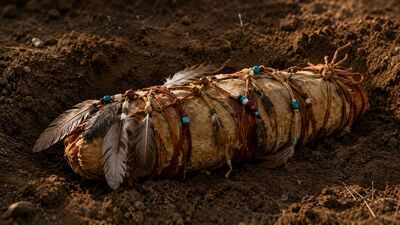
For decades, a small piece of Crazy Horse’s history may have been sitting beneath the ground in Minatare, Nebraska, with no marker to identify it. The object was not a weapon or a famous portrait of the Oglala Lakota leader. It was his medicine bundle, a private collection of sacred belongings that was treated with great care by the people who inherited responsibility for it. The bundle was eventually buried about six feet underground in 1942, when the Second World War made its owners uncertain about what lay ahead. Years later, the family returned to find that Minatare had changed so much that the hiding place could no longer be identified.

Why Crazy Horse entrusted his medicine bundle to Fast Thunder before 1877

The story begins shortly before Crazy Horse died in 1877. According to historian Thomas Powers, the Oglala leader entrusted his medicine bundle to his close friend Fast Thunder. After Crazy Horse was killed, Fast Thunder carried the bundle to the newly established Pine Ridge Reservation, where it remained within the family rather than becoming a public relic. Fast Thunder died in 1914. His wife, Jennie Wounded Horse, continued to protect the bundle and eventually placed it in the care of Nellie Ghost Dog. From there it passed to Theodore Means, Fast Thunder’s grandson. The chain of custody stretched across roughly six and a half decades, with the bundle remaining a private possession rather than something displayed or discussed openly. Medicine bundles are packages containing items considered sacred by their owners, potentially including stones, herbs, beads or hair.That privacy matters to the story. The bundle was not simply an old object associated with a famous historical figure. It had been entrusted to particular people, and its meaning was tied to Lakota traditions and family responsibility.

How Theodore Means hid the Crazy Horse medicine bundle six feet underground

During the 1930s, Oglala Lakota workers travelled from Pine Ridge to the North Platte Valley for seasonal agricultural jobs. Theodore Means was among those who found work in Minatare, where people came to pick potatoes. Then the Second World War changed the circumstances around the annual migration.In the autumn of 1942, Means decided the bundle needed to be hidden. He buried it in Minatare, roughly six feet below the ground, intending to protect it while he was away. The following year, he joined the army and went to war. The location was remembered using the landscape around it. A large cottonwood tree served as an important landmark. That might have seemed sufficient at the time. But the people who buried the bundle could not have known how dramatically the area would change over the following decades.The Nebraska History records the later account of the burial and the family’s attempt to recover it. The original Nebraska History article, “The Crazy Horse Medicine Bundle”, was written by Thomas Powers and appeared in volume 95 of the publication in 2014.

How changes in Minatare made the Crazy Horse medicine bundle impossible to locate

Theodore Means died in the early 1960s. Several years later, in 1968 or 1969, his wife Theresa returned to Minatare to search for the place where the bundle had been buried. It was no longer the same landscape. According to the Nebraska State Historical Society, many of the enormous cottonwood trees had been removed. Roads had also changed as cars became more common, altering parts of the town and its surroundings. The landmarks that had once made the burial place recognisable were gone, leaving Theresa unable to determine exactly where the bundle had been placed. That is how a possession that had been carefully handed down from one person to another became lost.There is no known modern marker identifying the spot. History Nebraska describes the bundle as being “six feet deep somewhere in Minatare, Nebraska”, making the location an unresolved part of the story rather than a confirmed archaeological site.

Why the family never identified the contents of the Crazy Horse medicine bundle

The contents were never properly identified. That uncertainty is one of the most striking parts of the story. A medicine bundle could contain objects regarded as sacred or powerful by its owner. But what Crazy Horse himself placed inside his bundle is not established by the surviving account. The family apparently did not recover the contents before the bundle was buried again. Powers’s account adds a more unusual detail. According to the family story, when the bundle was opened before burial, those present heard a sudden disturbance of owls outside the tent. In Lakota tradition, owls could be understood as warnings associated with death. The family became frightened and stopped opening the bundle, wrapping it again before putting it into the ground.That episode belongs to an oral family account rather than something that can be independently verified as an event. It is therefore best understood as part of the story preserved by the family, not as evidence that the bundle contained any particular object. The official Nebraska History account itself ends with the uncertainty. It says that the bundle may have remained a mystery by design and quotes Powers describing the lost bundle as a division “between the things that are lost and the things that survive.

How Crazy Horse’s lost medicine bundle differs from the famous Crazy Horse Memorial

The lost bundle is sometimes easily confused with the much larger public story surrounding Crazy Horse’s name in the Black Hills of South Dakota. The Crazy Horse Memorial, begun in 1948, is an enormous mountainside sculpture honouring the Lakota leader. Its origins go back to Lakota elder Henry Standing Bear, who approached sculptor Korczak Ziolkowski with the idea of creating a monument to Native American leaders. The project remains unfinished. A separate source discussing the memorial notes that the planned carving is intended to become one of the largest sculptures in the world. But the two stories point in almost opposite directions. The memorial is a public representation of Crazy Horse, while the medicine bundle was kept private and passed quietly through family hands.That distinction is important because Crazy Horse himself has long been associated with an absence of confirmed photographic portraits. The separate account supplied for this article notes that he avoided photographers and that the location of his burial was also kept undisclosed. The medicine bundle fits into that broader pattern of an individual whose history contains deliberate silences. A public monument can preserve a name and an image. A hidden bundle preserves something else: an object that was never intended to become a public display.


Source link

UK Muslim charity under terror probe over alleged Hamas ties after senior figure arrested in US case


UK Muslim charity under terror probe over alleged Hamas ties after senior figure arrested in US case
UK-based Muslim charity is being investigated by counter-terror police and the Charity Commission over alleged links to Hamas (Representational image)

A UK-based Muslim charity is under investigation by counter-terror police and the Charity Commission over alleged links to Hamas. A senior figure associated with one of the charity’s partner organisations was arrested in Britain in a US terrorism-financing case, triggering the investigation.The Al-Khair Foundation, which reported more than £74 million in income in the year to July 2025, became the subject of a statutory inquiry by the Charity Commission on Friday. Counter Terrorism Policing London has also opened an investigation and searched two properties in Croydon. No arrests have been made in the UK investigation.The developments followed the July 31 arrest in Britain of Mohammad Yousef Hasna, a Turkish national whom US authorities accused of conspiring to provide money and supplies to Hamas. The US Department of Justice has not publicly named the organisation it describes in its case as a “sham charity”, while the Al-Khair Foundation says Hasna was employed by one of its implementing partners rather than by the foundation itself.According to the US case, Hasna allegedly used his position at a purported humanitarian organisation to coordinate with senior Hamas figures over fundraising and the movement of goods into Gaza. Investigators allege that he and a senior Hamas official discussed sending truckloads of purported humanitarian aid to warehouses controlled by Hamas before distribution in Gaza.The US allegations also centre on encrypted messages allegedly exchanged between Hasna and Ghazi Hamad, described by investigators as a senior Hamas leader. The messages allegedly showed discussions about fundraising, commodities and using the charity’s name and warehouses to facilitate deliveries. US investigators further allege that Hasna altered photographs and documents to conceal Hamas’s alleged role as the beneficiary.The case has put a spotlight on the scale of Al-Khair’s operations. The Telegraph reported that the charity’s income had risen from about £31.3 million to £74.8 million after the October 7 Hamas attacks, while Charity Commission data showed it received more than £130 million in donations and legacies during 2024 and 2025. The charity has also claimed more than £9 million in Gift Aid over five years, according to the Telegraph.The Charity Commission said its inquiry will examine how closely Hasna was connected to Al-Khair, whether trustees properly vetted international partners and whether the charity adequately monitored how its funds were used overseas. The regulator has also restricted certain financial transactions by the foundation without its prior consent.The investigation also follows earlier scrutiny of the charity’s work in Gaza. The Telegraph reported that the Israeli military said in 2024 that one of Al-Khair’s workers, Hossam Mansour, had been killed while allegedly serving as a Hamas platoon commander. Al-Khair disputed that characterisation, describing Mansour as a senior aid worker involved in humanitarian work.Al-Khair has denied wrongdoing and said it is cooperating with the authorities. The foundation said its work in Gaza has included food, hot meals, clean water, medical assistance, shelter materials and support for orphans and families. It said it maintains governance and compliance systems intended to ensure that aid reaches its beneficiaries.Hasna, meanwhile, remains in UK custody pending extradition proceedings to the United States, where he faces charges including conspiring to provide material support to Hamas, conspiring to finance terrorism and financing terrorism. Each charge carries a maximum sentence of 20 years, according to the US Justice Department.The UK investigation is separate from the US criminal case. Counter Terrorism Policing said its inquiries are continuing and that it remains in contact with the Charity Commission and US authorities. The Charity Commission stressed that it cannot investigate criminal matters itself and would refer evidence of criminal activity to police.


Source link

Montreal man, 51, charged with death threats against Canadian PM Mark Carney


Montreal man, 51, charged with death threats against Canadian PM Mark Carney
 Canadian Prime Minister Mark Carney

A 51-year-old Montreal man has been arrested and charged with allegedly making death threats against Canadian Prime Minister Mark Carney, the Royal Canadian Mounted Police (RCMP) said.Marc-Andre Porlier was charged with uttering threats to cause death or bodily harm to a person under Section 264.1 of Canada’s Criminal Code, the RCMP Federal Policing Eastern Region said in a statement Monday.Police alleged that Porlier made the threatening remarks in an email sent to a senator, among other individuals.The RCMP said its investigation began on August 5 and led to Porlier’s arrest shortly afterwards.Porlier appeared at the Montreal courthouse on August 8.“The RCMP takes seriously any threats that can affect one’s sense of security. Violent statements will not be tolerated,” police said, adding that perpetrators could face criminal charges carrying significant sentences.The RCMP urged anyone with information about the alleged threats or other illegal activity to contact police.Earlier threat against CarneyThe latest case is not the first time Carney has faced an alleged death threat this year.In March, the RCMP said its Federal Policing Northwest Region’s National Security Enforcement Section in Manitoba had arrested a 55-year-old Winnipeg man, Paul Rindall, in connection with threats targeting the prime minister.RCMP said a national security investigation had begun in January after an account on X, formerly known as Twitter, allegedly posted multiple threats against Carney. The account also allegedly contained posts inciting hatred against Jewish and Muslim communities.Rindall was charged with three counts of uttering threats to cause death, according to the RCMP.The RCMP’s Federal Policing branch investigates national security-related offences, including terrorism, espionage, cyberattacks, foreign interference and threats involving internationally protected persons.As part of its protective mandate, the force is also responsible for safeguarding designated Canadians and certain foreign diplomatic personnel in Canada.


Source link

Two Pakistanis, one Indonesian killed in Houthi attack on cargo ship in Bab el-Mandeb


Two Pakistanis, one Indonesian killed in Houthi attack on cargo ship in Bab el-Mandeb
3 crew members killed in Houthi attack on ship in Bab al-Mandeb, report (Representational Image)

Houthi militants attacked a commercial vessel transiting the Bab al-Mandeb Strait, killing three crew members, according to initial reports by government-affiliated broadcasters. Al-Jumhuriya TV identified the victims as two Pakistani nationals and one Indonesian national.The vessel came under fire while passing through the strategic waterway linking the Red Sea and Gulf of Aden, maritime sources said. The attack highlighted the continued risks to commercial shipping along a key global trade route, which has faced repeated attacks in recent months.Authorities were assessing the extent of the damage and investigating the circumstances of the attack, while regional observers warned that further escalation could pose greater risks to maritime security and international trade.This is a developing story.


Source link

Indians can get UAE visa free for 3 months: Check eligibility, rules and booking process


Indians can get UAE visa free for 3 months: Check eligibility, rules and booking process
Abu Dhabi offers free entry visas for eligible Indian passport holders.

Indian travellers have a new reason to plan a UAE holiday, with Abu Dhabi offering free entry visas for eligible Indian passport holders under a three-month tourism programme, Gulf News reported.The programme will run from August 1 to October 31, 2026, and will initially cover up to 20,000 visas.Indian travellers must book through a participating travel partner or online travel agency, stay for at least three consecutive nights at an Abu Dhabi hotel and have a return flight from India.The visa benefit is linked to the qualifying holiday package and cannot be claimed through an independent visa application.

Free UAE visa offer for 3 months

The initiative, launched by the Department of Culture and Tourism – Abu Dhabi (DCT Abu Dhabi), is valid from August 1 to October 31, 2026, and will initially cover up to 20,000 visas.Under the programme, DCT Abu Dhabi will cover the full cost of the UAE entry visa for eligible Indian travellers booking an Abu Dhabi holiday through participating travel partners or online travel agencies.

Who can avail the offer?

The scheme is open to Indian passport holders travelling from India, but the free visa is linked to a qualifying Abu Dhabi holiday package.Travellers must:

  • Book through a participating travel partner or online travel agency
  • Stay at least three consecutive nights at an Abu Dhabi hotel
  • Have a return flight from India

The offer does not mean the UAE has introduced visa-free entry for all Indian passport holders. Instead, the visa cost is waived for eligible bookings under the limited-period programme.

How the free visa works

According to Gulf News, participating travel partners can process the visas through a DCT-appointed destination management company, with the tourism department covering the cost directly.Travel partners can also continue using their existing destination management companies, with DCT Abu Dhabi reimbursing Dh285 for each visa issued.

India remains key tourism market

The three-month initiative is part of Abu Dhabi’s efforts to attract more visitors from India and strengthen its travel partnerships in the country.Abdulla Yousuf, Director of International Operations at DCT Abu Dhabi, said India remains one of Abu Dhabi’s most important international markets and that covering visa costs would make it easier for Indian travellers to choose the emirate.The programme is also aimed at encouraging visitors to spend more time exploring Abu Dhabi’s culture, entertainment, hospitality and natural attractions.


Source link

Congo’s Ebola death toll crosses 2,000 as country battles fastest-growing outbreak


Congo’s Ebola death toll crosses 2,000 as country battles fastest-growing outbreak
A health worker in protective gear looks on at an Ebola treatment centre. (Photo: AP)

Congo’s confirmed Ebola death toll has risen to 2,011, with the second 1,000 deaths recorded in about three weeks compared with roughly nine weeks for the first 1,000, as the country battles the fastest-growing Ebola outbreak on record.The latest government figures put the number of confirmed infections at 4,381 across five provinces, less than three months after authorities declared the outbreak on May 15.According to the Associated Press (AP), 704 patients were admitted and in isolation as health teams continued efforts to contain transmission, including in some of the country’s hardest-to-reach areas.

Second 1,000 deaths recorded in about three weeks

It took roughly nine weeks after the outbreak was declared for the confirmed death toll to reach 1,000. The next 1,000 deaths were recorded in about three weeks.The virus had been circulating for months before authorities detected the outbreak. The World Health Organization (WHO) said genetic analysis indicated transmission since February, while subsequent research suggests it may have begun as early as January in Ituri province.Some early infections were mistaken for malaria and typhoid, delaying detection. Contact tracing has also been hampered by insecurity, poor infrastructure, population movement and pressure on health services, with many new infections emerging outside known transmission chains.The outbreak is caused by Bundibugyo virus, a type of Ebola for which there is no approved vaccine or proven treatment.WHO on July 2 added the first molecular diagnostic test specifically designed to detect Bundibugyo virus to its Emergency Use Listing, allowing faster confirmation of suspected infections.

Congo records its largest Ebola outbreak

The current outbreak is Congo’s 17th since Ebola was first identified in the country in 1976 and is now its largest by recorded case count. Globally, it is second only to the 2014-2016 West Africa epidemic, which recorded 28,616 cases and 11,310 deaths across Guinea, Liberia and Sierra Leone.

US raises Ebola assistance to $512 million

The US on August 5 announced another $242 million for the response, taking its total assistance to $512 million. The State Department said the additional funding would support up to six months of response operations.US officials said the assistance had supported more than 180 health facilities and helped distribute nearly 300 tonnes of supplies.President Donald Trump said on May 18 that he was concerned about the outbreak and that it remained confined to Africa at the time. The administration also imposed entry restrictions and enhanced screening for travellers from affected countries.The US Centers for Disease Control and Prevention (CDC) has said no outbreak-linked Ebola cases have been reported in the US.A WHO-sponsored clinical trial is testing the monoclonal antibody MBP134 and remdesivir, separately and in combination, to determine whether they can improve survival among people with Bundibugyo virus disease. Separate vaccine candidates targeting the virus are also being studied as researchers seek new tools to control the outbreak.


Source link

Over 95% of Ukrainian PoWs report torture, ill-treatment in Russian captivity: United Nations


Over 95% of Ukrainian PoWs report torture, ill-treatment in Russian captivity: United Nations
Since February 2022, the UN human rights office has documented 129 executions of Ukrainian PoWs. (File Photo)

More than 95% of Ukrainian prisoners of war interviewed by UN monitors reported being tortured or otherwise ill-treated in Russian captivity, a senior UN human rights official said Monday, as Russia rejected the allegations and accused Ukraine of abusing Russian captives.Since February 2022, the UN human rights office has documented 129 executions of Ukrainian PoWs at the start of captivity and 48 deaths in detention attributed to torture, denial of medical care or other inhumane conditions, UN Assistant Secretary-General for Human Rights Claudia Fuentes Julio said.More than half of the Ukrainian PoWs interviewed also reported sexual violence, including rape, beatings while naked and electric shocks to the genitals.Fuentes Julio said monitors had received accounts of severe beatings with batons, heavy belts and wooden objects, as well as electric shocks, dog attacks and mock executions.

Former PoWs recount abuse

Former captives and Ukrainian officials described their experiences at an informal UN Security Council meeting, according to Reuters.Juan Alberto Leyva Garcia, who remains in the Ukrainian military, said he spent 1,183 days in Russian captivity, where he faced daily beatings, electric shocks, excessive exercise in sub-zero temperatures and sexual abuse.He said two friends died after being beaten at detention centres in the Donetsk region. Garsiya also described overcrowded barracks, saying dysentery affected almost every PoW and many prisoners were starving.Crimean Tatar activist Leniie Umerova, who was freed in a 2024 prisoner exchange, said she was detained while trying to reach Crimea to visit her seriously ill father. She said she was transferred between seven detention facilities and accused Russian authorities of torturing Ukrainians in custody.Oleg Gushin of Ukraine’s Coordination Headquarters for the Treatment of Prisoners of War said Kyiv had identified more than 300 detention sites in Russia and Russian-occupied Ukrainian territory. More than 9,000 Ukrainians had returned through prisoner exchanges, while thousands remained in Russian captivity, he said.

Russia rejects allegations

Russia’s deputy UN representative Maria Zabolotskaya rejected the allegations as “a disinformation campaign” and accused Ukraine of subjecting Russian prisoners to torture, degradation and physical and moral abuse.UN monitors have also documented torture and ill-treatment of Russian and third-country PoWs held by Ukraine. About half of those interviewed reported abuse during the early stages of captivity, Fuentes Julio said, while adding that the scale differed fundamentally from the treatment documented among Ukrainian prisoners.Ukraine’s charge d’affaires Volodymyr Pavlichenko urged countries to increase pressure on Russia and pursue accountability over the treatment of prisoners.


Source link

In 1970, Sylvia Earle led five women into an underwater lab for 14 days, helping prove humans could live and work beneath the sea | World News


In 1970, Sylvia Earle led five women into an underwater lab for 14 days, helping prove humans could live and work beneath the sea

The sea can feel distant even to people who live hundreds of miles from a coastline. It sits beyond the horizon, beneath ships and far below the surface, largely hidden from ordinary view. Sylvia Earle spent much of her life trying to make that hidden world less remote. Born in New Jersey in 1935, she grew from a child fascinated by wild plants and animals into a marine biologist, deep-sea explorer, inventor and conservationist. Her career unfolded alongside major changes in underwater technology, allowing her to spend thousands of hours beneath the surface. She lived in an underwater habitat, explored the deep sea in submersibles and became the first woman to serve as chief scientist of the US National Oceanic and Atmospheric Administration.

Sylvia Earle’s childhood love of nature led her to marine science

Sylvia Earle was born on August 30, 1935, in Gibbstown, New Jersey. Her early surroundings were not especially exotic. Her family lived on a small farm near Camden, where she spent time outside exploring woods and paying attention to the plants and animals around her.Her parents had not attended university, but they shared an interest in nature. They encouraged their daughter to treat unfamiliar creatures with curiosity rather than fear. When she was 13, the family moved to Clearwater, Florida, placing her close to the Gulf of Mexico. Earle began spending more time studying the coast and its wildlife, and the ocean gradually became the natural world she most wanted to understand. Earle attended Florida State University and supported herself in part through laboratory work.

Sylvia Earle took her marine biology research beyond the laboratory

Earle chose botany as her speciality, concentrating on marine plants and the role vegetation plays within an ecosystem. She later completed postgraduate study at Duke University, earning a master’s degree and, in 1966, a doctorate.Her doctoral research examined the brown algae of the eastern Gulf of Mexico. Earle was interested not merely in identifying organisms but in understanding the communities in which they existed. Her scientific career was already developing while she was raising a family. In 1964, when her children were two and four, she spent six weeks aboard a National Science Foundation expedition in the Indian Ocean. After completing her doctorate, Earle worked as a research fellow at Harvard before becoming resident director of the Cape Haze Marine Laboratory in Florida. In 1968, she descended roughly 100 feet in the Bahamas aboard the submersible Deep Diver. She was four months pregnant at the time.

The underwater laboratory that put her in the public eye

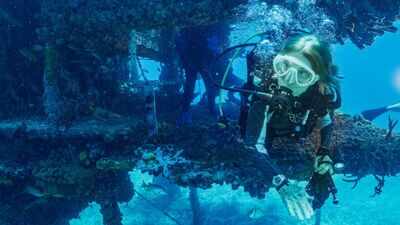
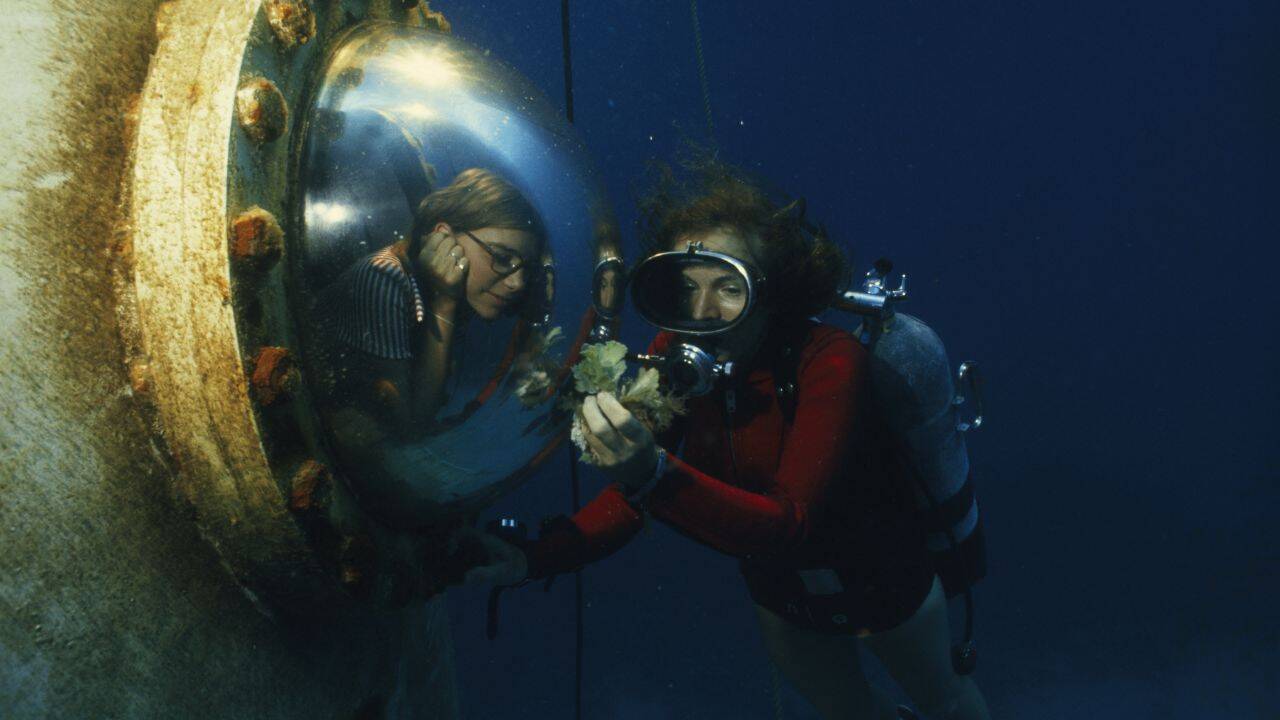
By the end of the 1960s, Earle had already accumulated more than 1,000 hours underwater. She applied to take part in Tektite, an ambitious project that placed scientists in an underwater habitat off the Virgin Islands.The project had several purposes. Scientists could study marine environments while living beneath the surface for extended periods, while NASA was also interested in what the experience might reveal about people living and working in isolated environments. NOAA’s historical records describe Tektite II as an important stage in the development of underwater habitats and saturation diving.In 1970, Earle led an all-female team of five scientists in Mission 6. The women spent two weeks in the underwater habitat, around 50 feet below the surface near St John in the US Virgin Islands. NOAA records the group as the first all-female saturation team associated with the programme.Life inside the habitat was not quite the austere experiment that might be imagined. There were bedrooms, a kitchen, a shower, a television and laboratory equipment. The surrounding ocean, however, was the main attraction. Earle later described spending long stretches outside, watching fish and other marine creatures move through the changing light. The Tektite II mission attracted considerable attention, and the scientists suddenly found themselves being discussed outside specialist circles. There were public appearances, a White House reception and a ticker-tape parade.

Sylvia Earle led five women into an underwater lab for 14 days, helping prove humans could live and work beneath the sea<br>

PC: National Geographic

The dive that took her 1,250 feet down

As reported by Academy of Achievement, one of Earle’s most unusual expeditions came in 1979, when she descended to 1,250 feet beneath the surface near Oahu, Hawaii. She was wearing a Jim suit, a rigid, pressurised diving suit designed to maintain roughly one-atmosphere pressure around the diver. Rather than remaining attached to the submersible, Earle left the vessel and walked across the sea floor.For about two and a half hours, she moved independently at a depth that was extraordinary for a human being at the time. A communications line connected her to the submersible, but there was no ordinary physical connection between herself and the surface.She later wrote about the experience in Exploring the Deep Frontier, published in 1980. The expedition illustrated something that had become increasingly important in her career: the machinery used to reach the ocean was not simply transportation. It determined what scientists could see, touch and investigate.

Sylvia Earle turned ocean exploration into underwater technology

Earle’s interest in technology eventually became a business venture. In the 1980s, she and engineer Graham Hawkes established Deep Ocean Engineering and Deep Ocean Technologies.The companies worked on remotely operated and human-occupied underwater vehicles, including Deep Rover and Deep Flight. The idea was straightforward enough: if researchers could not safely or practically reach certain depths themselves, machines could extend their reach.Deep Rover became an important example of that approach. Developed with collaborators including Can-Dive and supported by Canadian government funding, it was launched in Halifax in 1984. Scientific dives followed, including work around Monterey Canyon in California. Earle’s career had come full circle in an unusual way. The young scientist who had wanted to see marine life directly was now helping develop the equipment that could make deeper observation possible.

A government role brought the condition of the sea into sharper focus

In the early 1990s, Earle stepped away temporarily from her companies to serve as chief scientist of the National Oceanic and Atmospheric Administration.She was involved in monitoring the health of US waters and also reported on environmental damage associated with the burning of Kuwaiti oil fields during the Gulf War. Her appointment was significant in another respect: Earle became the first woman to serve as NOAA’s chief scientist.

Sylvia Earle turned ocean exploration into a global conservation mission

Earle later established the Sylvia Earle Alliance and Mission Blue, an organisation centred on ocean protection. The idea of identifying important marine areas and giving them stronger protection became one of the defining features of her conservation work.In 2009, she received the TED Prize, using the platform to call for a worldwide network of protected marine areas. She refers to these places as “Hope Spots” — areas considered important to the health of the ocean and worthy of focused conservation efforts.Her work has continued well beyond the period when most people would consider an exploration career complete. In 2016, at 81, she returned to the water to study deep coral reefs near Oahu. By then, she had logged more than 7,000 hours underwater and led more than 80 expeditions, according to the American Academy of Achievement.She has also held the position of Explorer-in-Residence at the National Geographic Society and was involved in the Google Ocean Advisory Council, helping provide scientific oversight for ocean content in Google Earth.


Source link