


What is MDR that is being proposed for UPI transactions, who pays the final cost? Explained

Unified Payments Interface or UPI transactions have become an important backbone of the digital payments economy in India. With wide adoption and transactions running into several lakh crore every month, UPI is an important payments enabler for the common man, small and big businesses.But the service which has remained free so far, may in the coming days see the imposition of a Merchant Discount Rate or MDR. Does that mean that people will have to pay a fee for UPI transactions? No.The government has clarified that UPI will continue to remain free for consumers and no transaction charges will be applicable to person-to-person payments. The government has also said that if an MDR is introduced in the future it will only be applicable to a limited category of merchant transactions with the rate being nominal and much lower than the MDR currently applicable on credit or debit card transactions.We reported last week that a threshold of Rs 2,000 is being considered with a possible MDR of 0.25% to 0.4%. This means that routine transactions like milk, vegetables and groceries will not come under this charge.What is a Merchant Discount Rate? How is it currently applicable on credit or debit cards and why is it being proposed for UPI transactions? Who will pay the final cost of the MDR for UPI transactions?
What is MDR and how the system currently works for credit cards
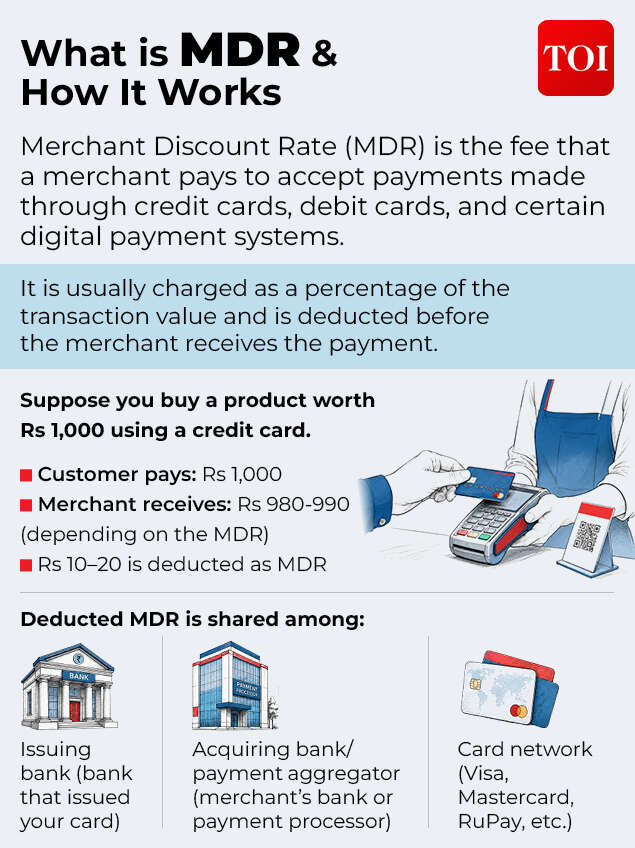
Let’s first understand what is Merchant Discount Rate:Merchant Discount Rate is essentially a fee that a merchant who is selling goods or services has to pay to accept payments that are made through credit cards or debit cards. The fee is usually a certain percentage of the transaction value and is deducted by the bank before the merchant receives the final payment.According to Vivek Iyer, Partner and Financial Services Risk Advisory Leader, Grant Thornton Bharat, MDR for credit cards comprises three components – interchange fee (which is paid to the card issuer bank), network/switching fee (which is paid to the card settlement provider like Visa/Master/Amex ) and to the acquirer bank (that onboard the merchant).
What is MDR & how it works
Let’s understand this better with an example:You buy something for Rs 10,000 and make the payment through your credit card. Let’s say a 2% MDR is applicable – which means the Merchant Discount Rate is Rs 200. While you pay Rs 10,000, the merchant receives only Rs 9,800, with the Rs 200 deducted as MDR.This Rs 200 is distributed between the three mentioned above with the largest going to the interchange fee and lowest going to the card settlement provider, says Vivek Iyer.Also Read | No charges for UPI users: Government clarifies person-to-person transactions to remain free; top points
Why MDR is being proposed for UPI
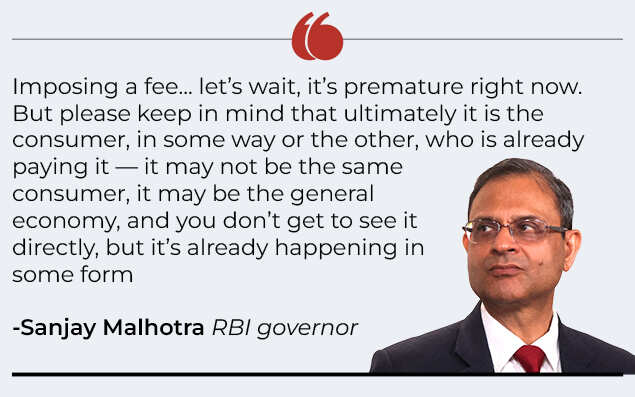
The government has said that the proposed amendment to the Payment and Settlement Systems Act aims to make the UPI ecosystem financially sustainable. This is because the transaction volumes are growing, requiring continued investment in infrastructure, cybersecurity and fraud prevention.A self-sustaining revenue model would help support competition and future expansion.RBI governor Sanjay Malhotra has said that the cost is already being paid indirectly by the economy.“Now, costs have to be paid by someone — it’s a public [good]; we all want this particular infrastructure to continue to strengthen, become more efficient. That’s our focus as of now — let’s watch how developments proceed,” Malhotra said last week.“…Please keep in mind that ultimately it is the consumer, in some way or the other, who is already paying it – it may not be the same consumer, it may be the general economy, and you don’t get to see it directly, but it’s already happening in some form,” he said.Ranadurjay Talukdar, Partner and Payments Sector Leader, EY India points out that credit or debit cards and UPI sit on very different cost structures today.“On credit cards, MDR is unregulated and can run up to about 3% of the transaction value, largely because banks and payment networks carry fraud, rewards and chargeback costs,” he tells TOI.
What RBI governor said on UPI
Non-RuPay debit is capped at 0.40% (max 200) for transactions in small merchants with less than Rs 20 lakh in annual turnover and 0.90% (max 1000) for large merchants with turnover above 20 lakhs. Rupay debit cards have zero MDR, much like UPI.UPI, by contrast, has been mandated to carry no MDR since the government’s zero-MDR push, with the small MDR that existed pre-2020 (up to 0.30% on person-to-merchant transactions) removed in January 2020 to accelerate adoption.“That’s the structural gap the current amendment is trying to address: UPI has scaled to 2,366 crore transactions worth Rs 29.9 lakh crore in July 2026 alone without a revenue stream funding the banks and fintechs that play a critical role to run the rails,” he tells TOI.Also Read | Will you have to pay to use UPI? 7 FAQs on possible MDR and what it means for consumers answered
Who pays the final cost?
Merchants. Experts note that even for credit and debit cards the cost is borne by merchants, though some can pass it on as a convenience charge.“RBI rules bar merchants from passing it (MDR) directly onto customers. In practice, though, the fee is usually absorbed by the merchant, though some pass it through as a convenience charge, and where it isn’t itemised, it tends to get folded into pricing,” Ranadurjay Talukdar of EY India tells TOI.“The government has said that consumers won’t face any transaction charges on UPI, and all P2P and P2PM transfers stay free. And the government has said it would be threshold-based, apply to a limited set of merchant transactions, and sit below card MDRs. So direct pass-through to consumers is meant to be structurally blocked, the same way it’s technically restricted on cards today,” Talukdar says.“The final decision on whether and how much MDR gets applied sits with the NPCI-led UPI and Services Steering Committee, so the specifics are still being worked out. The challenge will be in implementation by acquiring banks and PAs, given incorrect reporting of merchant turnover and issues around MCC misclassification, which need to be corrected,” he adds.
UPI Charges: What Changes & What Doesn’t
Mihir Gandhi, Partner and Leader – Fintech and Payments Transformation, PwC India says that if the proposed pricing of MDR on UPI is introduced for large value merchants and for higher value transactions, then it is expected that the merchant will bear the cost of MDR on UPI (as they are anyways factoring in the MDR cost of cards) and this cost is expected to be lower than the MDR cost of cards.But Vivek Iyer of Grant Thornton Bharat believes that since merchants play in a competitive market, the ability to increase prices is limited. “Hence we don’t believe that costs are indirectly included by merchants in the product costs,” he says.For non-Rupay debit cards the MDR is RBI capped and for Rupay Debit Cards MDR is zero since January 2020 to drive digital payment adoption.“When MDR is introduced on UPI, we expect the merchants to largely adopt the same practice as they adopt for debit cards, as that is a surrogate closer to UPI,” he adds.
What FM Sitharaman has said:
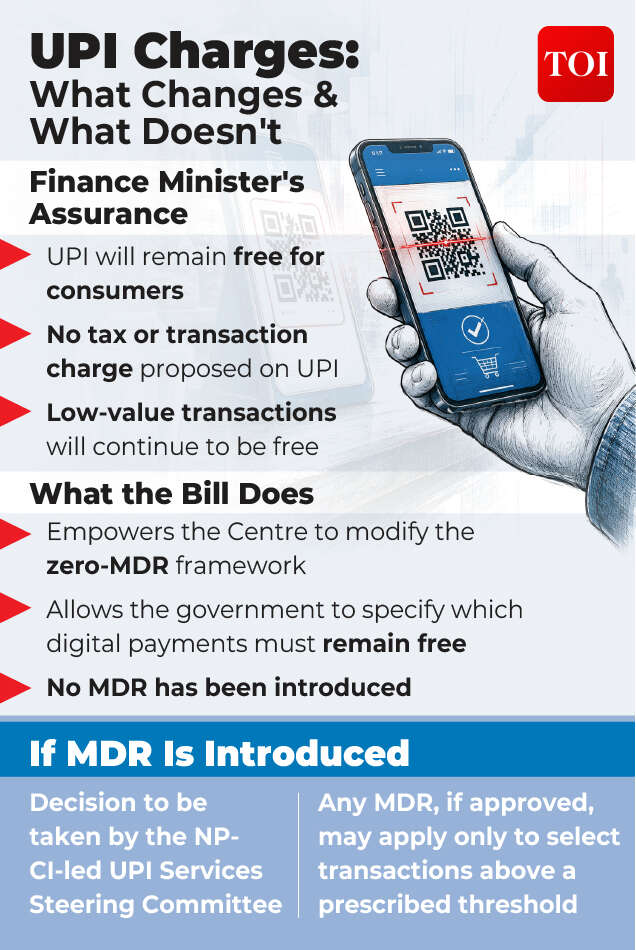
Finance Minister Nirmala Sitharaman has sought to assure consumers that UPI transactions will continue to be free of them. She clarified that the Taxation and Other Laws (Amendment) Bill does not provide for any tax or transaction fee on UPI payments.She has said if an MDR is introduced in the future, it would only be for transactions above a set threshold.Who will decide the applicability of MDR? The UPI Services Steering Committee, chaired by the National Payments Corporation of India (NPCI). The committee will examine whether an MDR should be introduced and if so what should be its scope and structure.
What FM Sitharaman has clarified
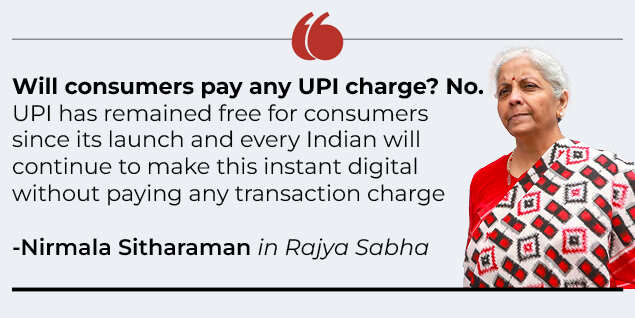
“Will consumers pay any UPI charge? No,” Sitharaman said in the Rajya Sabha. “UPI has remained free for consumers since its launch and every Indian will continue to make this instant digital without paying any transaction charge,” Sitharaman said.According to Sitharaman, financial inclusion and protecting small businesses remain a priority and consumers will not have to pay any fee for day-to-day routine low value transactions.What the amendment does is provide the government with the legal authority to change the existing zero-MDR framework that currently governs UPI and RuPay transactions. As of now, banks and payment system providers are not allowed to impose any direct or indirect charges on payments that are made via UPI or RuPay debit cards.