

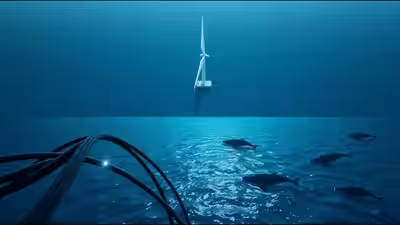

California is developing a smart mooring line that could detect whale entanglements and monitor floating wind turbines |
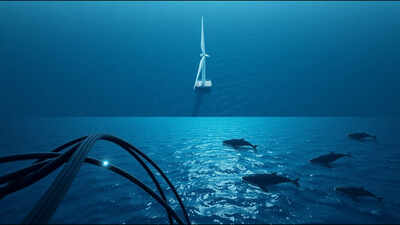
California’s push into offshore wind energy faces a problem most coastal states never had to solve. The state’s strongest winds sit far from shore in water too deep for turbines fixed to the seafloor, meaning any large-scale project has to rely on floating structures instead. Floating turbines bring their own headaches, since constant wave motion, shifting tidal loads and long distances from land make routine inspection and maintenance slow and expensive. Researchers are now trying to turn one part of that same structure into the solution. With funding from the California Energy Commission, a team led by Lawrence Berkeley National Laboratory is developing a smart mooring line fitted with fibre optic sensors that can monitor a turbine’s structural health while also listening for whale calls and detecting the moment a whale becomes entangled nearby.
Why floating wind turbines need a different kind of monitoring
Most offshore wind farms built so far, including those along the American Atlantic coast, sit in shallow enough water to use fixed bottom foundations anchored directly into the seabed. California’s coastline offers no such option for much of its strongest wind resource, since the continental shelf drops off quickly, leaving floating platforms as the only realistic path to capturing that energy. According to Lawrence Berkeley National Laboratory’s own account of the project, California’s Pacific waters can be strong enough only 20 miles offshore to generate more than double the energy of shallower sites, but the depth involved makes floating systems the only viable choice for much of that potential. Floating structures also experience far more constant motion than fixed ones, which complicates both their design and the ongoing task of keeping them safe to operate.
How fibre optic cables can sense strain, vibration and sound
The technology at the centre of the project relies on distributed fibre optic sensing, a method that sends light down a thin glass-cored cable and analyses how that light scatters and returns. According to a project description from the California Energy Commission, this approach allows operators to monitor vibration, strain and temperature throughout a structure continuously rather than relying on periodic manual inspection. The same cables can also pick up ambient underwater sound, including whale vocalisations, meaning a single sensing system embedded into a turbine’s mooring line could simultaneously track the health of the structure itself and monitor marine life moving through the surrounding water.
What earlier testing revealed about the technology’s sensitivity
This is not the first time researchers have tested fibre optic sensing on offshore wind hardware. A study titled Structural health monitoring of offshore wind turbines using distributed acoustic sensing (DAS), published in the Journal of Civil Structural Health Monitoring and led by James T. Xu alongside Berkeley Lab scientist Yuxin Wu, tested a full-scale, 25-metre-tall wind turbine tower on a shake table at the Pacific Earthquake Engineering Research Centre at the University of California, Berkeley. Researchers subjected the tower to bending and multidirectional shaking meant to simulate the kind of ocean-driven stress a floating turbine would face, while fibre optic cables installed throughout the structure tracked how it deformed under pressure. One of the study’s clearest findings was that the sensing system proved sensitive enough to detect loose bolts at the tower’s joint connections, a routine maintenance issue that can otherwise go unnoticed until it becomes a serious structural problem.
Why the mooring line itself is becoming a sensing device
Building on that earlier structural work, the smart mooring project extends the same underlying sensing approach to the cables that anchor a floating turbine to the seafloor. Rather than functioning purely as a mechanical connection, the mooring line becomes an active monitoring system in its own right, continuously reporting on both its own structural condition and the activity occurring in the water around it. The California Energy Commission has identified real-time entanglement detection, structural monitoring and environmental acoustic monitoring as the project’s central goals, reflecting a dual purpose rarely combined in a single piece of offshore hardware.
What this could mean for whales living near future wind farms
Whale entanglement in fishing gear and other underwater lines remains a serious and closely tracked risk in ocean conservation, and floating wind farms introduce yet another set of mooring cables into waters whales regularly pass through. A sensing system capable of detecting both a whale’s call and a physical tug on the line offers a way to catch potential entanglements as they happen rather than after the fact, giving operators a chance to respond in near real time. Berkeley Lab researcher Yuxin Wu, who has led earlier fibre optic testing on turbine towers, has described the long-term goal as building what amounts to a nervous system for offshore wind structures, one capable of reporting on its own condition continuously rather than waiting for scheduled human inspection.
Why this approach could shape future offshore wind projects
If the smart mooring system performs as intended, researchers say the underlying concept could extend well beyond California’s coastline to any floating offshore wind project operating in waters shared with marine mammals. Better monitoring of how these structures interact with the ocean around them could also inform how future wind farms are sited and operated more broadly, offering regulators and developers more direct evidence of a project’s real environmental footprint rather than relying on periodic surveys alone. As floating offshore wind moves from early pilot projects toward larger-scale deployment along the Pacific coast, technology capable of listening as carefully as it measures could end up shaping how, and where, these turbines are allowed to operate.