

The United States removed 100 outdated dams in 2025, reconnecting more than 4,893 river miles across 30 states and setting a single-year record for upstream habitat


The United States removed 100 outdated dams in 2025, reconnecting more than 4,893 river miles across 30 states and setting a single-year record for upstream habitat
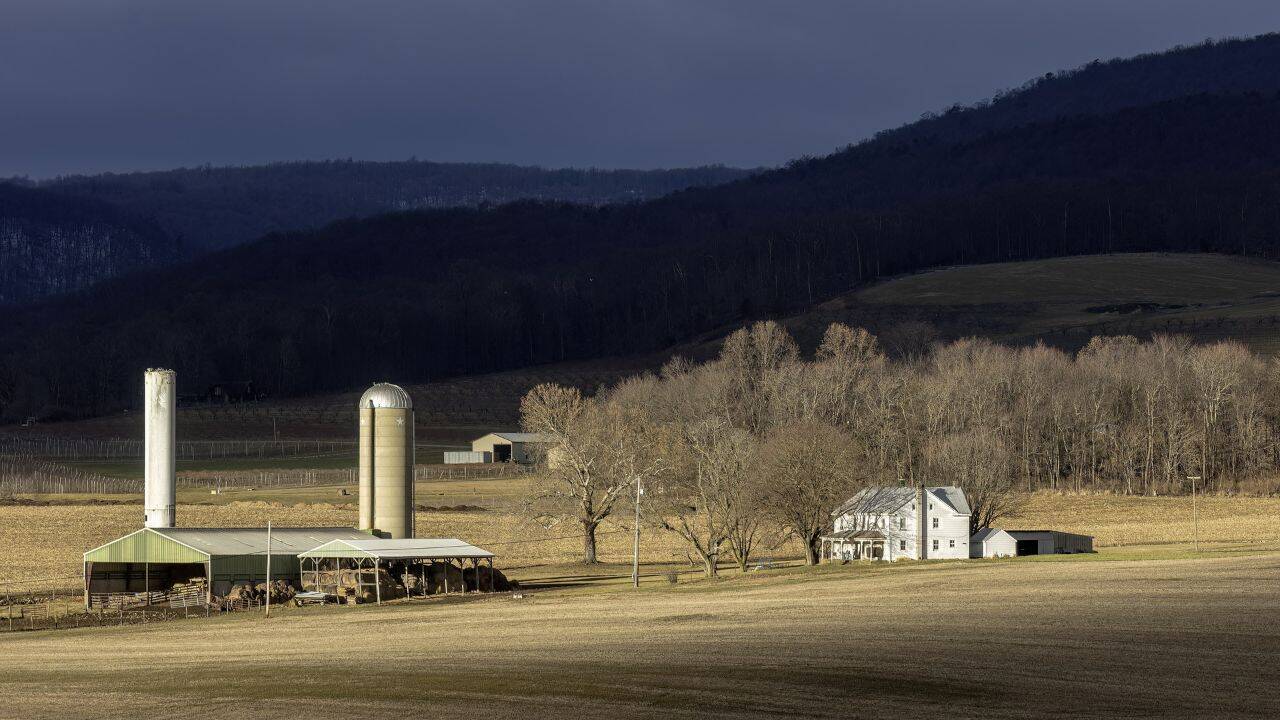
Dam removal on the Middle Fork Nooksack River, Washington (American Rivers photos)

The United States removed 100 dams across 30 states in 2025, reconnecting more than 4,893 miles of rivers, according to a report by the organisation American Rivers. The organisation said it was the largest number of upstream river miles reconnected through dam removal in a single year in the US.The removal of these dams has allowed water to flow freely again in places where rivers had been blocked for decades, and in some cases, for centuries. The work is also helping restore access to habitats used by fish and other wildlife.Pennsylvania removed the highest number of dams in the US in 2025, with 14 structures taken out. The state now has 433 documented dam removals since 1912.Other states in the Northeast also recorded significant numbers. Massachusetts removed 11 dams in 2025, while Vermont removed nine. Flooding in both states has highlighted the need to address failing dams and undersized road-stream crossings.

Why are old dams being removed?

Many dams in the US are no longer serving the purpose for which they were originally built. The country has more than 500,000 dams in its national inventory, and many are no longer generating power, supplying water or serving another practical purpose. At the same time, they can affect river ecosystems and public safety.Dams can change the way rivers naturally flow. When a dam blocks a river, it can prevent fish from reaching spawning areas upstream. Water held behind dams can also become warmer and more stagnant. Additionally, some ageing can also create safety risks and increase flooding concerns during storms.Ecology was the most commonly cited reason for dam removal in 2025. It was given as a reason for 59 of the 100 projects completed during the year. Dilapidated or failing structures were the second most common reason, with 37 projects. Safety concerns were cited in 20 projects.The effects can begin soon after a dam is removed. The report said bugs can return within days, while native fish can reach sections of rivers they had been unable to access for generations within weeks.
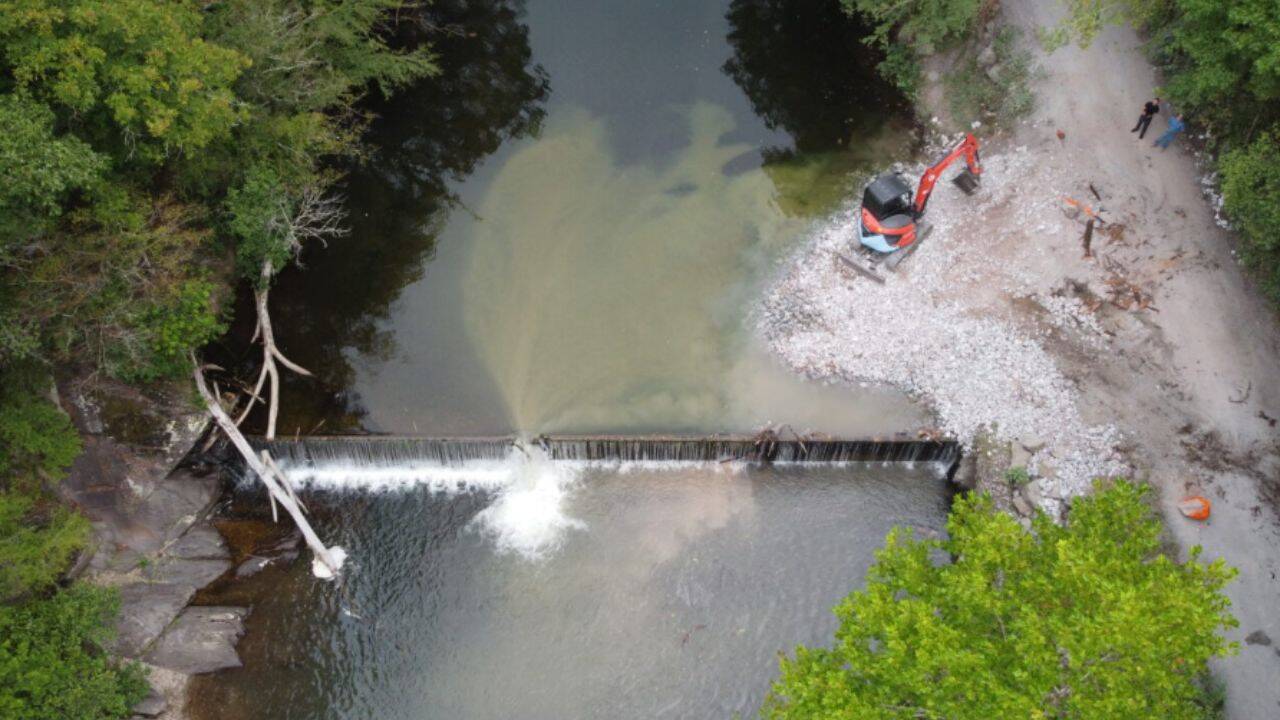
Lower Citico Dam removal, Citico Creek, Tennessee

Lower Citico Dam removal, Citico Creek, Tennessee

Restoring wildlife habitat

Some of the projects completed in 2025 show how removing a single structure can reconnect large parts of a river system. In Iowa, the Forest City Dam was removed from the Winnebago River. The project reconnected 99 upstream miles for fish passage and opened wetland spawning habitat for northern pike. It also reduced flood risk to a local park.In Delaware, the historic DuPont Experimental Station Dam on the Brandywine River was removed as part of a wider effort involving multiple dams. A previous dam removal upstream in 2019 had already helped change the river. After that project, American shad were seen spawning in the Brandywine in Wilmington for the first time in more than 100 years.The return of the fish showed how river restoration can affect species that had been unable to reach parts of their former habitat for generations.In Virginia, the Georges Mill Dam was removed from the South Mayo River. Seven people had drowned at the site over the years. Removing the dam improved passage for the endangered orangefin madtom and also removed a site that had become a serious safety hazard.Another major project took place in Maine. The removal of Mill Pond Dam on the Sabattus River was part of a wider effort to open access to 2,429 acres of spawning habitat and 75 miles of stream for sea-run fish.The area could support an annual run of more than one million adult alewives. The fish are an important food source for wildlife, including eagles and whales.

Cultural importance

Dam removal projects are also connected to the cultural practices of Indigenous communities in some places. In California, the Jenny Creek Diversion Dam near the Klamath River was removed by Trout Unlimited and the state Department of Fish and Wildlife. The Yurok Tribe and Shasta Indian Nation also took part in the cleanup and cultural monitoring.A similar restoration effort took place in Utah’s Zion National Park, where the Temple of Sinawava Dam was removed. The project was part of an effort to restore the Virgin River, which is a Wild and Scenic River.American Rivers said the 2025 projects also showed the role of local communities, government agencies, conservation groups and Tribal Nations in restoring rivers. It now wants to build on the progress made in 2025 and its target is to remove 30,000 dams by 2050.



Source link

‘Emergence of Indian barrels notable’: Why Russia is buying gasoline from India for the first time


‘Emergence of Indian barrels notable’: Why Russia is buying gasoline from India for the first time
Global energy markets continue to be affected by the twin impact of two major geopolitical conflicts.

Russia has started importing gasoline from India for the first time as repeated Ukrainian attacks on its refineries have deepened fuel shortages in the domestic market. Global energy markets continue to be affected by the twin impact of two major geopolitical conflicts.While Ukraine has intensified its campaign targeting Russian refineries, tensions between the US and Iran have continued in the Middle East. Together, these disruptions have tightened fuel supplies, prompting Russia, traditionally an exporter of refined fuels, to prohibit exports of both gasoline and diesel in order to prioritise domestic demand.

In a first, Russia imports gasoline from India

According to Kpler data quoted in a Bloomberg report, this marks Moscow’s first import of gasoline from the South Asian nation. The long-distance shipment underscores the severity of the supply crunch that Russia is facing.Also Read | Reverse oil flow: India supplies gasoline to Russia – why it mattersKpler data shows the first cargo arrived on August 5, with additional shipments expected to follow. Nayara Energy Ltd, the Indian refiner backed by Russia’s largest oil producer Rosneft PJSC, has emerged as a supplier. The fuel is being transported through a chain of Russian-linked tankers, involving ship-to-ship transfers off the coast of Egypt, the Bloomberg report said.“The emergence of Indian barrels is particularly notable,” said Sumit Ritolia, lead analyst at Kpler. He said the shipments, alongside continued imports from Belarus and other neighbouring markets, demonstrate “the severity of the current domestic gasoline imbalance, and the extent to which lower refinery runs are reshaping Russia’s traditional product trade flows.”EA Analytics estimated that, following successive attacks, Russia’s crude processing averaged 3.6 million barrels a day in July, roughly one-third below the normal seasonal level. Since then, Ukraine has stepped up its strikes, targeting five refineries last week and at least two more this week.After being sanctioned by the European Union in July last year, Nayara Energy has increasingly depended on so-called dark-fleet tankers and ship-to-ship transfer operations to import crude and export refined products.Its 400,000-barrel-per-day refinery at Vadinar on India’s west coast has also been seeking to diversify its export markets after one of its major buyers, Hindustan Petroleum Corp., recently increased its own fuel production in the region.For the first shipment, the Russian-flagged products tanker Cyclone, loaded around 42,000 tonnes of gasoline at Vadinar on June 18, according to ship-tracking data compiled by Bloomberg.The cargo was subsequently transferred to the Oman-flagged tanker Garnet through a ship-to-ship operation at Damietta Port off Egypt’s Mediterranean coast on July 6. Garnet later arrived in Russia in early August.Also Read | 100% tariffs: Why India may ignore Trump threat and continue buying Russian crude oil

More shipments to follow

Additional shipments appear to be in the pipeline. According to Kpler, the product tanker Varg loaded nearly 40,000 tonnes of gasoline at Vadinar on July 6 and is believed to have completed a ship-to-ship transfer at Damietta toward the end of July, based on changes in the vessel’s draft. Such transfers are commonly used to reduce overall voyage times for individual ships.Kpler has not confirmed the receiving vessel for that cargo, although it identified Beast as a likely candidate. The tanker was present at Damietta and showed an increase in draft between July 30 and 31. While Beast had declared Morocco’s Tangier as its destination, tracking data showed it subsequently sailed past the port and is now heading north in the Atlantic Ocean with the cargo still onboard.Ship-tracking data also showed that another products tanker, the Cameroon-flagged Photon, departed Vadinar on July 13 before transferring its gasoline cargo to the Russia-flagged Talisman at Damietta during July 28-29.With the exception of Garnet, all of the vessels involved are classed under the Russian shipping register. Every ship has been sanctioned by the European Union, while Garnet and Talisman are also subject to US sanctions.“The final destination of Talisman and Beast remains unconfirmed but the emerging trading pattern suggests Damietta STS hub continues to facilitate the movement of Indian-origin gasoline toward Russian import channels,” Kpler said in a report.Also Read | Beijing’s billion-barrel weapon: Why India must prepare for China-driven oil prices


Source link

Sri Lanka announce 16-member squad for India Test, Kusal Mendis ruled out


Sri Lanka announce 16-member squad for India Test, Kusal Mendis ruled out
Sri Lanka’s Kusal Mendis (AP/PTI)

Sri Lanka Cricket (SLC) have announced a 16-member squad for the opening Test of their two-match series against India, with veteran wicketkeeper-batter Niroshan Dickwella making his return to the Test side.Dhananjaya de Silva will captain the team, while Kamindu Mendis has been named his deputy. Dickwella has been included as the wicketkeeper after Kusal Mendis was ruled out of the first Test with an injury.Batter Pathum Nissanka has also been left out of the squad for the opening match.Lahiru Udara, Nishan Madushka, Dinesh Chandimal, Pasindu Sooriyabandara and Sonal Dinusha make up the rest of Sri Lanka’s batting options.The hosts have three specialist spinners in Ramesh Mendis, Prabath Jayasuriya and Keshara Nuwantha. Their pace department includes Milan Rathnayake, Asitha Fernando, Lahiru Kumara, Vishwa Fernando and Dilshan Madushanka.The first Test will be played at the Galle International Cricket Stadium from August 15 to 19. The two-match series is part of the ICC World Test Championship 2025-27 cycle.India, led by Shubman Gill, are currently fifth in the World Test Championship standings. They have recorded four wins and four losses in nine matches, with a Points Percentage (PCT) of 48.150.Sri Lanka are sixth in the standings, having registered one win, one draw and two defeats.With home conditions expected to play a role in the series, Sri Lanka will look to their experienced players, including Chandimal and the returning Dickwella, as they prepare to take on India’s Test side.Sri Lanka squad: Dhananjaya de Silva (captain), Lahiru Udara, Nishan Madushka, Kamindu Mendis (vc), Dinesh Chandimal, Pasindu Sooriyabandara, Sonal Dinusha, Niroshan Dickwella (wk), Ramesh Mendis, Prabath Jayasuriya, Keshara Nuwantha, Milan Rathnayake, Asitha Fernando, Lahiru Kumara, Vishwa Fernando, Dilshan Madushanka.


Source link

Rhea Chakraborty opens up about life after jail, facing awkward reactions and being misunderstood: ‘People would stop laughing and joking around me’ |


Rhea Chakraborty opens up about life after jail, facing awkward reactions and being misunderstood: 'People would stop laughing and joking around me'
Rhea Chakraborty opens up about life after jail, facing awkward reactions and being misunderstood: ‘People would stop laughing and joking around me’

Rhea Chakraborty recently spoke about the controversy surrounding Sushant Singh Rajput‘s case, choosing to address the difficult period with humour. The actress shared that people around her used to stop laughing and joking whenever she would enter the room. Here’s what the actress talked about regarding her tough time post SSR’s demise.

Rhea Chakraborty recalls people’s reaction

The actress appeared on a YouTube video by comedian Tanmay Bhat, where she reacted to memes alongside a panel of comedians, including Rohan Joshi, Kushagra Srivastava, Aaditya Kulshreshth and Piyush Sharma.During the conversation, Tanmay Bhat recalled his own AIB controversy and how people would speak to him with exaggerated sympathy at the time. Rhea said she faced something similar. “With me, if people were like laughing and joking in a group and if I came in there, then suddenly they would like change the tone be like, ‘Ha ha ha, oh hi Rhea, how are you?'” she said, mimicking the sudden shift in tone.Tanmay noted that while they were comfortable joking about their own controversies, others found it surprising to see them laugh about it. Rohan Joshi joined in jokingly, saying, “How can you? Like Rhea, how could you say that? Don’t you know what you’ve been through?”Rhea agreed, adding, “It’s true though, like if I would make these jokes like we’re doing today, like four years ago, the room would suddenly just get very heavy. They didn’t know whether they should laugh or they should not laugh.”

Rhea Chakraborty reacts to her ‘Imma bounce’ message

Tanmay also brought up the incident where Rhea’s personal WhatsApp message, “Imma bounce,” was misinterpreted by a news channel as “cheque bounce.” He recalled, “Dude, remember there was that crazy shit, man. Remember like Rhea saying, ‘Imma bounce,’ and everyone was like, ‘Some cheque is bouncing.'” Rohan added, “That was the dumbest thing ever. I will never forget that. After that, I thought I, like, I never want to be misunderstood. I have never said, ‘I am a head’ ever again.”Piyush joked, “No cap. Rhea refuses to wear a cap,” leaving everyone laughing. Rhea, who recently made her acting comeback, added, “Now, if I, if someone even texts me, ‘I’m on the pot,’ I’m like, ‘Please specify’,” triggering another round of laughter. She then quipped, “Good guys, good guys. You find my trauma very entertaining. I’m glad someone’s laughing.”

Rhea Chakraborty’s work front

On the work front, Rhea Chakraborty will next feature in the second instalment of ‘Traitors’. The show will be hosted by filmmaker Karan Johar.


Source link

‘Small revolution’: France bans unsolicited telemarketing calls without consent


‘Small revolution’: France bans unsolicited telemarketing calls without consent
A person uses his phone near the Eiffel Tower in Paris, Wednesday. (File Photo)

France has banned unsolicited telemarketing calls unless consumers have given prior permission, in a move described by a consumer advocacy group as a “small revolution” for consumers.The ban, which took effect on Tuesday, applies to businesses across all sectors. Companies can still contact customers about an existing contract, but they must obtain consent before making marketing calls.A 2025 parliamentary report found that 97% of people in France were annoyed by unsolicited sales calls. It also found that 72% of French people received calls on their mobile phones at least once a week, while 38% said they were contacted daily.The report described telemarketing as “one of those rare issues that unites people in France”.Businesses making marketing calls will now need prior approval from consumers and must retain evidence of that consent.Consumer advocacy group Que Choisir Ensemble welcomed the move, calling it a “small revolution” for the sales industry.“It cannot be stressed enough that peace and quiet is a right, and it is time to stop exposing consumers to unwanted solicitations,” the group said in a statement.Its president Marie-Amandine Stévenin said the issue extended beyond telephone marketing.“This observation also holds true online and on the street, which are saturated with demands to consume,” she said.Stévenin said the organisation had long campaigned “for an end to the automatic assumption that someone in their home or private life is a potential customer.”“This is a victory for consumers, the vast majority of whom do not want to receive sales calls,” she said.The new restrictions have raised concerns among businesses and in Morocco, where the call-centre industry relies heavily on the French market.A Moroccan government minister estimated that the restrictions could put up to 50,000 jobs at risk, according to a report in newspaper Le Matin.France’s direct-selling industry has also criticised the new requirements.Frédéric Billon, head of the Fédération de la Vente Directe (FVD), said companies would face additional administrative burdens.“You’ll have to obtain written consent from your customer, and you’ll also have to keep proof of that consent,” Billon said in comments reported by the New York Times.

European countries take different approaches

France’s move comes as Germany, Austria and Italy already have restrictions on unsolicited telemarketing calls.The UK has a less restrictive approach. Most cold calls remain legal as long as the recipient has not objected and the number is not on the statutory list covering people or businesses that do not wish to receive such calls.


Source link

‘Searched for suicide spots’: Mystery deepens over Bengaluru techie missing ahead of wedding in January | Bengaluru News


'Searched for suicide spots': Mystery deepens over Bengaluru techie missing ahead of wedding in January
Advait Upadhyay, an IIT alumnus with a master’s degree in cybersecurity.

BENGALURU: Search operations for 31-year-old cyber security professional Advait Upadhyay resumed on Wednesday, with nearly 100 personnel from the National Disaster Response Force (NDRF), State Disaster Response Force (SDRF), Forest Department and police scouring the treacherous slopes of Shivagange Hill in Nelamangala taluk.

Drone spots ‘body’

The operation took a crucial turn after high-resolution drones spotted what appeared to be a body trapped amid dense vegetation at the base of Shantala Drop, a notoriously steep and dangerous cliff point on the hill.Police deployed specialised body-found metal detectors from the Bengaluru City Police Commissionerate along with drones to help teams navigate the difficult terrain.

Advait went missing after solo trek

Advait, an IIT graduate residing in Kadugodi with his fiancée Prapti Chauhan, went missing on Friday after setting out on a solo trek. He had informed Chauhan about his trekking plan before leaving. The couple was set to get married in January.CCTV footage from the foothills showed Advait parking his rented motorcycle and beginning his climb around 7.30am. Before ascending, he sent a selfie to Chauhan from the hilltop, but his mobile phone was switched off shortly afterwards.Technical analysis later showed that his phone’s last known location signal had pinged near Kudur on Kunigal Road, an area away from the standard trekking path.

Police examine suicide angle

During a parallel investigation at his residence, police examined Advait’s laptop and found search histories relating to the depth and topography of Shivagange Hill and Shantala Drop. He had also searched for suicide locations around Bengaluru.Police, however, said they were keeping all possibilities open and were also examining the possibility of foul play or other explanations.“Nearly 100 search personnel are braving persistent rain and slippery cliffs to reach the visual location flagged by the drone. We are keeping all possibilities open, examining both a suicide angle based on his search history and potential foul play or alternate theories,” police sources told TOI.Teams push towards Shantala DropPersistent rain and slippery cliffs have made the search operation challenging. Specialised teams are continuing to move towards the location identified by the drone at the base of Shantala Drop.Search and rescue operations remain ongoing as multiple agencies work to locate Advait.


Source link

‘Mirzapur: The Movie’ cast fees revealed: Pankaj Tripathi charges Rs 15 crore, becomes the highest paid star dwarfing Ali Fazal, Divyenndu Sharma, Shweta Tripathi’s remunerations – Report |


'Mirzapur: The Movie' cast fees revealed: Pankaj Tripathi charges Rs 15 crore, becomes the highest paid star dwarfing Ali Fazal, Divyenndu Sharma, Shweta Tripathi's remunerations - Report
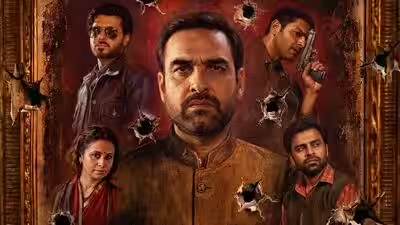
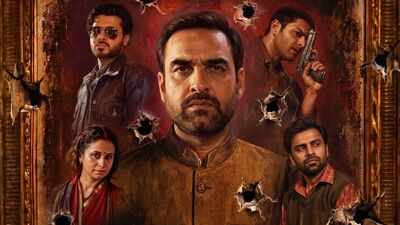
Mirzapur The Movie cast fees revealed (Image Credits Instagram)

The trailer for ‘Mirzapur: The Movie’ has been released and fans are buzzing about the return of the original cast members who once ruled the OTT space. With big names including Pankaj Tripathi, Ali Fazal, Divyendu Sharma, Ravi Kishan, and others reuniting on the big screen, viewers have been left curious about how much each star charged for the full-fledged theatrical film. Here’s a breakdown of the reported cast fees for ‘Mirzapur: The Movie.

Pankaj Tripathi reportedly charges Rs 15 crore, becomes the highest-paid actor

As per varied reports from Filmii Talks, NDTV and Free Press Journal, Pankaj Tripathi, who reprises his role as Kaleen Bhaiya in Mirzapur: The Movie, allegedly charged a whopping Rs 15 crore for the much-awaited film. With this reported fee, he is said to be the highest-paid actor associated with the project.

Ali Fazal and Divyenndu Sharma‘s reported fees for ‘Mirzapur: The Movie’

Ali Fazal, who returns as fan-favourite Guddu Pandit aka Guddu Bhaiya, reportedly took home Rs 4 crore for the film. Divyenndu Sharma, who reprises his popular role as Munna Tripathi, reportedly charged Rs 3 crore for his part in the project.

Jitendra Kumar and Shweta Tripathi‘s fees for ‘Mirzapur: The Movie’

Jitendra Kumar, who takes over the role of Bablu Pandit aka Yadav Ji in the film, replacing Vikrant Massey, who played the character in the original series, reportedly charged Rs 1.5 crore. Shweta Tripathi, who reprises her role as Gajgamini “Golu” Gupta, reportedly earned Rs 95 lakh for Mirzapur: The Movie.

‘Mirzapur: The Movie’s budget

As per Flickonclick and Free Press Journal, ‘Mirzapur: The Movie’ has a reported budget of around Rs 250 crore. The report notes that this figure remains an estimate and has not been officially confirmed by the makers. The reported budget reflects the massive scale of the theatrical adaptation as the popular Amazon Prime Video series, ‘Mirzapur’ franchise makes its ambitious and fan demanded big-screen debut.

About ‘Mirzapur: The Movie’

The official trailer for ‘Mirzapur: The Movie’ was released on August 11, 2026, ahead of its theatrical release scheduled for September 4, 2026. Directed by Gurmmeet Singh and written by Puneet Krishna, the film brings back franchise favourites Pankaj Tripathi as Kaleen Bhaiya, Ali Fazal as Guddu Pandit, and Divyenndu Sharma as Munna Tripathi, along with Ravi Kishan, Jitendra Kumar, Rasika Dugal, Shweta Tripathi, and others. The movie is produced by Ritesh Sidhwani and Farhan Akhtar under Excel Entertainment.DISCLAIMER: Figures presented in this article are derived from various public sources and are considered approximate unless explicitly noted. We may include direct input from celebrities or their teams when available. We are open to feedback on toientertainment@timesinternet.in.


Source link

With a massive 242,000 acres, Bill Gates is the largest private farmland owner in the United States | World News


With a massive 242,000 acres, Bill Gates is the largest private farmland owner in the United States
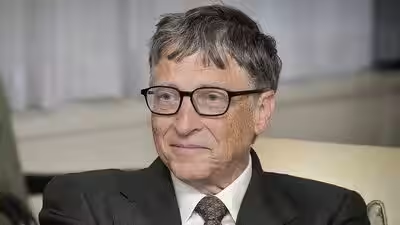
William (Bill) H. Gates, founder, technology advisor of Microsoft Corporation. Image Credit: Ken Shipp/ Wikimedia commons

Bill Gates, the co-founder of Microsoft, has shifted from a global technology leader into the most significant private owner of farmland in the United States. His portfolio now spreads to approximately 242,000 acres of agricultural land, which represents a massive investment in the nation’s soil. His name is sometimes associated with software and global health initiatives, but the shift into the agricultural sector highlights a growing trend of wealthy private interest in rural property.Much of these holdings are concentrated in the southern states, particularly in Louisiana and Arkansas, where vast stretches of productive land are now managed by his investment. This development has given rise to a widespread conversation among agricultural communities and economists about the impact of non-farming landlords.

Total amount of farmland owned by Bill Gates in the US

According to ‘Arkansas Money & Politics,’ Gates has accumulated a total of 268,984 acres of land across the country. The majority of this contains farmland, but the portfolio also includes more than 25,000 acres of transitional land and over 1,200 acres used for recreation. The distribution of these holdings is particularly dense in the Delta region. In Louisiana, the Gates family owns 69,071 acres, which represents more than a quarter of their entire land portfolio. Arkansas is close to this number, with total holdings of 47,927 acres.Despite these vast numbers, the Associated Press reports that Gates does not own the majority of American farmland. To put it in perspective, the United States Department of Agriculture reported there were roughly 895 million total acres of farmland in the country in 2021. This means that Bill Gates is indeed the largest private owner, but his holdings account for less than 1% of the total agricultural land in the US.

Total amount of farmland owned by Bill Gates in the US

Image Credit: Wikipedia

Why Bill Gates is investing heavily in the American soil

Bill Gates has indicated that his investment group is focused on environmental and scientific goals. As reported by the Associated Press, he suggested that these acquisitions are connected to the development of more productive seeds and the advancement of biofuels. He believes that better seeds can help in preventing deforestation and help regions like Africa in dealing with climate difficulties. Furthermore, he noted that cheap biofuels could eventually solve emissions problems in the aviation and trucking industries.However, there is also a clear financial logic to these purchases. Research fromLouisiana State University (LSU) explains that farmland has become a highly attractive alternative investment. Historically, farmland has acted as a hedge against inflation, which means that its value sometimes rises even when the purchasing power of money falls. The thesis notes that agricultural assets are different from traditional financial assets like stocks.

Private investment as a wider trend in American agriculture

The rise of Bill Gates as a landlord is part of a larger shift in how American land is owned and managed. The National Farmers Union points out that nearly 40% of US farmland is now owned by non-farmers who rent the land out to agricultural producers. In some specific regions, this figure is as high as 80%. This ‘financialisation’ of the countryside is causing the farmland to move from local families to the portfolios of pension funds, private equity firms, and wealthy individuals.

Private investment as a wider trend in American agriculture

A centre pivot irrigation system on a field. Image Credit: Laura Wilson farm , USDA Natural Resources Conservation Service

Concerns for the future of farmland in the United States

The National Farmers Union warns that the entry of wealthy investors like Bill Gates has pushed up the price of farmland, which makes it almost impossible for small-scale farmers to buy their own property. Since 1970, the price of an average acre of American farmland has more than tripled when adjusted for inflation. This has led to a situation where just 13% of farming operations now control 75% of the country’s cropland.There are also environmental concerns. The National Farmers Union explains that when farmers only rent land on short-term leases, they become less motivated to invest in long-term conservation practices like protecting soil and water quality. Landowners without agricultural experience may not understand the importance of these natural resources or may be unwilling to spend that rental income on the efforts for conservation. Roughly 400 million acres of land is expected to shift from one owner to the next in the coming decade, which suggests that the battle over who owns the American soil, and how they treat it, is just beginning.


Source link

Jai Hanuman Movie: ‘DC’ actress Wamiqa Gabbi joins Rishab Shetty’s ‘Jai Hanuman,’ character details under wraps – Report | Tamil Movie News


'DC' actress Wamiqa Gabbi joins Rishab Shetty's 'Jai Hanuman,' character details under wraps - Report

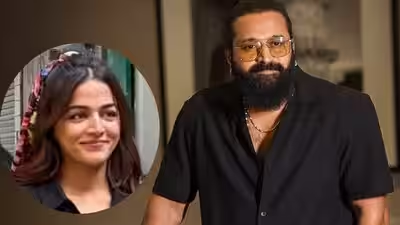
Wamiqa Gabbi, who recently made waves with her Tamil outing DC, has reportedly joined the cast of director Prasanth Varma‘s mythological action epic Jai Hanuman, starring alongside Rishab Shetty. While her character details remain under wraps, the casting adds another significant name to the ensemble as the film continues production in Hyderabad.According to a report by Bollywood Hungama, Wamiqa Gabbi has joined the cast of director Prasanth Varma’s Jai Hanuman. The actress is said to be playing a significant role in the film, although the makers have not yet revealed any details about her character. Her casting adds another notable name to the ensemble, which Rishab Shetty already leads. Reports suggest Wamiqa could join the Hyderabad shooting schedule in the coming weeks as production continues at a steady pace.

Wamiqa Gabbi’s growing line-up after ‘DC’ success

The new project comes at a crucial juncture in Wamiqa Gabbi’s career. The actress has been turning heads with her recent performances across genres and languages, with growing recognition among Tamil audiences following her role in Arun Matheswaran’s DC, which also marked the acting debut of director Lokesh Kanagaraj. The film opened well at the box office and has reportedly collected Rs 50 crore globally within its first five days. With Jai Hanuman now added to her list of upcoming projects, Wamiqa Gabbi appears to be heading into increasingly ambitious roles.

About ‘Jai Hanuman’

‘Jai Hanuman’ is a sequel to the 2024 superhero film Hanu-Man and forms part of the Prasanth Varma Cinematic Universe. While Teja Sajja played the lead in the first film, Rishab Shetty will step into the role of Lord Hanuman in the sequel. Development on the new film is being undertaken on a significantly larger scale, positioning it as a mythological action epic. The story will explore Hanuman’s power, his devotion, and his role in Kaliyug. Alongside Rishab Shetty, Wamiqa Gabbi has now been roped in to play a lead role, further fuelling curiosity ahead of the film’s eventual release.


Source link

Ramayana: ‘I was not impressed by Kaikeyi’s scene, her dressing is very modern’: ‘Mahabharat’ star Gajendra Chauhan reacts to Nitesh Tiwari’s ‘Ramayana’ trailer, praises Arun Govil as Dashrath and Ranbir Kapoor as Lord Ram | Hindi Movie News


'I was not impressed by Kaikeyi's scene, her dressing is very modern': 'Mahabharat' star Gajendra Chauhan reacts to Nitesh Tiwari's ‘Ramayana’ trailer, praises Arun Govil as Dashrath and Ranbir Kapoor as Lord Ram

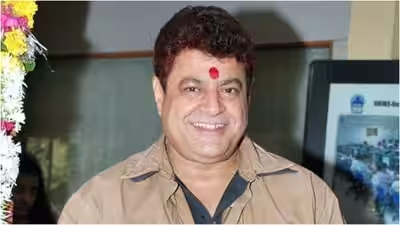
Gajendra Chauhan, best remembered for essaying Yudhishthir in BR Chopra’s ‘Mahabharat’, shared his views on Nitesh Tiwari’s much-anticipated ‘Ramayana’, which stars Ranbir Kapoor as Lord Ram and Yash as Raavan. Chauhan expressed that the trailer left him “not impressed,” although he did acknowledge that Ranbir looked convincing in the role of Ram.

Gajendra Chauhan on Kaikeyi’s portrayal and the exile scene

He clarified that what bothered him wasn’t so much how the actor looked, but rather how hard it is to strip away a star’s familiar image when they’re playing a mythological figure. “I saw the Ramayana trailer. Personally, I am telling you, I was not impressed,” Chauhan said. He was especially critical of how Kaikeyi’s character was portrayed, particularly the scene where she demands Ram’s exile, drawing a comparison to his own turn as Dashrath in BR Chopra’s Ramayan back in 2002. “I was not impressed by Kaikeyi’s scene where she asks for Ram’s exile. Her dressing, for one, is very modern. They have given her a modern sari,” he said.

Gajendra Chauhan felt the scene lacked emotional weight

Chauhan felt the scene also fell short emotionally. He remembered how Ravi Chopra had approached the Kaikeyi-Dashrath sequence in his own Ramayan, noting that the actors had spent almost a day and a half filming that portion alone. He believes the scene holds significant weight in the narrative, as it captures the unravelling of a family after Manthara manipulates Kaikeyi. He also shared his perspective on why casting big Bollywood names in mythological roles can be tricky. “Stars have an image. It is very difficult for that star image to be accepted in mythology. If you want to play these characters, you should not have too much of an image. You should not be too exposed to the public,” he said.

Gajendra Chauhan recalls his own ‘Mahabharat’ experience

Drawing from his own journey with ‘Mahabharat’, Chauhan pointed out that before taking on the role of Yudhishthir, he had already done films and roughly 25 television serials, yet hadn’t built a significant public image. “The image that was created for me came from Mahabharat, because before that I didn’t have an image,” he said. He went on to recall an earlier Mahabharat project that had been announced with a star-heavy lineup, including Amitabh Bachchan as Bhishma Pitamah, Hrithik Roshan as Karna, Ajay Devgn in another part and Aamir Khan as Krishna, noting that the project ultimately got shelved after two years.

Gajendra Chauhan on Ranbir Kapoor’s star image as Ram

Chauhan observed that Ranbir, on the other hand, comes with a firmly established image as a Bollywood star. “Here, Ranbir Kapoor has his own image. He is a very big star. Now he is playing Ram,” he said. Even so, he was careful to point out that he didn’t think Ranbir looked unconvincing in the part. “He is looking good, no doubt. He looks very good in the get-up,” he said. Chauhan further noted that audiences also hold a preconceived image of Lord Ram in their minds, something that can influence how a new portrayal is received. “We had an image of Ram in our imagination — that he would have a long nose, that he would look like a king, that kind of look,” he said. That said, he admitted that judging the film in full would be difficult going by the trailer alone. “Until the film is released and we see it in its totality, it is a little difficult to comment,” he said.

How do you feel about casting popular Bollywood stars in mythological roles?

3k+ users shared opinion today

5k+ users already voted today

3k+ users shared opinion today

Share Opinion

Gajendra Chauhan praises Arun Govil’s casting as Dashrath

Despite his reservations about certain elements of the trailer, Chauhan singled out the casting of Arun Govil as King Dashrath for praise. Govil is best remembered for portraying Lord Ram in Ramanand Sagar’s classic ‘Ramayan’, which aired in the late 1980s. “I think the best casting is Arun Govil as Dashrath,” Chauhan said. He felt that Govil’s own history of playing Lord Ram adds a layer of significance to his casting as Dashrath this time around. “He was Ram 40 years ago. After 40 years, he has grown into Dashrath. He has become a father,” Chauhan said. Describing Govil as a “fantastic actor,” he expressed confidence that he would bring the right depth to the role. “I think that is very good casting for Ramayana. He is looking good too,” he added.

Ramayana’s cast and release details

‘Ramayana’, directed by Nitesh Tiwari, comes with a sprawling star cast, Ranbir Kapoor as Lord Ram, Sai Pallavi as Sita, Yash as Raavan, Sunny Deol as Lord Hanuman and Ravi Dubey as Lakshman, with Arun Govil and Lara Dutta playing Dashrath and Kaikeyi respectively. Rakul Preet Singh, Vivek Oberoi and Saurabh Sachdeva complete the lineup. The film’s first part is scheduled to hit Indian screens on November 8, 2026, charting Ram’s formative years, his relationship with Sita, their marriage and the beginning of his 14-year exile, with the concluding chapter arriving in Diwali 2027.Gajendra Chauhan called Nitesh Tiwari’s ‘Ramayana’ trailer “not impressed,” criticising Kaikeyi’s modern portrayal but praising Ranbir Kapoor’s look as Ram. He recalled his own ‘Mahabharat’ journey and lauded Arun Govil’s casting as Dashrath, calling it apt given Govil once played Ram. The film releases November 8, 2026.


Source link