


North Korea Ballistic Missile Launch: North Korea fires second ballistic missile in a week ahead of US-South Korea war drills
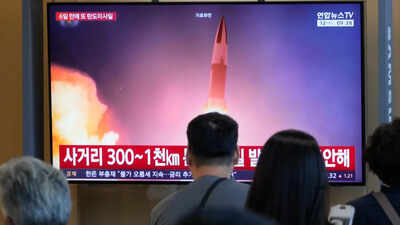

North Korea fires second ballistic missile in a week ahead of US-South Korea war drills
A TV screen shows a file image of North Korea’s missile launch during a news program at Seoul Railway Station (Picture credit: AP)

North Korea fired a ballistic missile towards the sea off the Korean Peninsula’s east coast on Wednesday, South Korean and Japanese authorities said, marking Pyongyang’s second reported ballistic missile launch in less than a week and coming days before major US-South Korea military exercises.South Korea’s Joint Chiefs of Staff said the missile was launched from the Wonsan area on the North’s eastern coast at around 6 am (local time) and travelled more than 700 km (435 miles).Japan’s defence ministry also detected the launch and said the missile landed in waters outside Japan’s exclusive economic zone (EEZ), between the Korean Peninsula and Japan.Japan said the missile reached a maximum altitude of about 90 km (56 miles.The latest launch came two days after South Korea and the United States announced that their annual Ulchi Freedom Shield military exercises would begin on August 17.The drills are scheduled to run until August 27 and are aimed at strengthening readiness against North Korea’s nuclear and missile threats.North Korea has repeatedly condemned the exercises, describing them as rehearsals for an invasion. The United States and South Korea have maintained that their military training is defensive.

Seoul, Tokyo condemn launch

South Korea’s National Security Council held an emergency meeting following the launch and described North Korea’s continued ballistic missile tests as acts of provocation. It urged Pyongyang to stop activities that violate UN Security Council resolutions.South Korea’s military said it remained prepared to respond to any provocation under its combined defence posture with the United States.According to Reuters, the military said it would respond “overwhelmingly” if necessary.Japan also lodged a protest with North Korea through diplomatic channels.“It’s a serious problem that affects the safety of the Japanese people,” Japanese defence minister Shinjiro Koizumi told reporters.Japan’s defence ministry said the missile landed outside its EEZ. Koizumi said Tokyo had “strongly condemned” the launch.There was no immediate statement from Pyongyang on Wednesday’s launch.

Second reported launch since August 6

The launch follows another reported ballistic missile test on August 6, when South Korea, the United States and Japan detected a short-range ballistic missile launched by North Korea.That was the North’s first reported ballistic weapons test since late June. North Korea did not immediately confirm that launch, although Pyongyang often releases details of weapons tests a day after they take place.The latest launches come amid a broader continuation of North Korea’s weapons-testing programme. The country has conducted tests involving short-range ballistic missiles, artillery rockets and other tactical weapons this year.Experts cited by news agency AP said North Korea has often used US-South Korean military exercises as a pretext to increase its own weapons testing.

Pyongyang continues to expand missile arsenal

UN Security Council resolutions prohibit North Korea from conducting ballistic missile launches.However, Pyongyang has continued developing its missile and nuclear capabilities, particularly since diplomatic efforts between North Korean leader Kim Jong Un and then-US President Donald Trump broke down in 2019.North Korea has since expanded its weapons arsenal and testing programme. Experts say Kim may seek to use the expanded capabilities to strengthen his negotiating position with Washington, including in any future discussions over sanctions.The latest test also comes as North Korea continues to strengthen its ties with Russia and China.North Korea has supplied troops and ammunition to support Russia’s war in Ukraine, while relations with China have also received renewed attention.Chinese President Xi Jinping visited Pyongyang in June, his first visit to the North Korean capital in seven years.



Source link

HasanAbi calls for permanent Asmongold ban from Twitch and YouTube as streamer feud explodes


HasanAbi calls for permanent Asmongold ban from Twitch and YouTube as streamer feud explodes

HasanAbi has reignited a fierce debate over streamer moderation after arguing that Asmongold should face permanent bans from both Twitch and YouTube. His comments came after Asmongold defended remarks that led to his recent Twitch suspension. Hasan questioned whether major platforms still enforce their rules consistently, while also pointing to what he sees as growing pressure from political groups and online campaigns.

HasanAbi says Asmongold should be permanently banned

During a livestream on August 9, HasanAbi responded to Asmongold’s YouTube video Why I’m Gone, in which the streamer addressed his two-week Twitch suspension. The controversy followed comments in which Asmongold described immigrants using dehumanizing language and advocated shooting people, including children, in a discussion about immigration.Rather than apologizing, Asmongold said he stood by his comments. That response became the focus of Hasan’s criticism.Hasan argued that Asmongold appeared to be testing how far Twitch and YouTube would allow him to go before taking stronger action. He also compared the current moderation environment with what he believes would have happened several years ago.“It’s pretty wild that I feel like this is a test. Right? He’s basically testing the boundaries of Twitch to be like, ‘Listen, what are you going to do? I’m not apologetic. I don’t care. I said what I said. Go ahead, keep me banned if you can. What’s wild about it is I feel like this is also testing the boundaries of YouTube’s terms of service, too. Because I feel like YouTube back in the day would quite literally ban someone for statements like this one.The argument places Asmongold’s suspension within a much larger discussion about platform rules. Twitch and YouTube have enormous creator communities, and decisions involving controversial political speech can quickly become flashpoints.

HasanAbi questions Twitch and YouTube moderation policies

Hasan also took aim at the business pressures he believes influence moderation decisions. He suggested that platforms may be increasingly cautious about taking action against prominent creators whose audiences could respond aggressively.“Oh, my god! It does say a lot about how things have gotten as far as like corporate culture in general that this will probably be a slap on the wrist by Twitch because they are ******* terrified of angering the right-wing masses that have spent a good deal of time doxxing people that work for the trust and safety team at Twitch. It’s like really ****** up!”Hasan went even further, saying Asmongold would likely have faced a permanent ban under the standards he remembers from previous years. He brought up Destiny as another example of a creator who, in his view, received harsher punishment for less serious remarks.“This would be an insta perma. Like, there is no shot! I would say, pre-Trump 2.0, this is a perma. Like, Destiny got banned for less, which is crazy to say. Like, he got perma’d for less, and he definitely deserved it! So, I don’t even know where we’re at now. You know? I feel like this would be a ban on ******* YouTube as well! Or at least a demonetization on YouTube as well!”The dispute now raises a familiar question for Twitch and YouTube: where should platforms draw the line between controversial political commentary and speech that violates their rules?Asmongold had not publicly responded to HasanAbi’s latest comments at the time of the report. For now, the clash between the two creators highlights how moderation decisions can become political battles of their own, particularly when major streamers are involved.


Source link

Quote of the day by Peter Thiel: ‘First mover advantage is a trap, it’s much better to be the last mover’


Quote of the day by Peter Thiel: 'First mover advantage is a trap, it's much better to be the last mover'
Quote of the day by Peter Thiel.

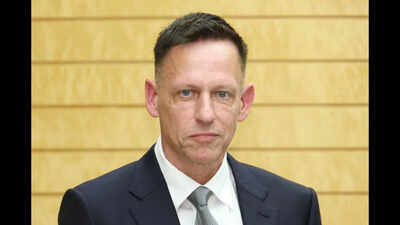
PayPal founder Peter Thiel contradicted the well-known business lesson that being the first mover in a sector has its own advantage and suggested that it is highly overrated and a trap. Because first-movers can become unseated by a new entrant and he supported his theory by citing how Microsoft remained the last operating system for a long time, Google the last search engine for a long time and neither first mover. Thiel presented this idea on several occasions: in his speeches and books, and said, ‘First mover advantage is a trap; it’s much better to be the last mover’. While starting early might generate temporary buzz, it rarely creates lasting value, he believes. What actually matters in business is not who enters the arena first, but who stays there last. In Thiel’s view, the ultimate goal of any ambitious startup is not to be a pioneer, but to become the last mover in its category — the company that makes the final major breakthrough and secures an unassailable monopoly for decades to come.

What is first-mover advantage?

The conventional wisdom in Silicon Valley has long celebrated the first-mover advantage. Business schools and startup incubators frequently teach that getting to a market first allows a company to capture brand recognition, secure early customers, and set the standards for an entire industry. Thiel rejects this premise as a dangerous distraction. Being first, he points out, often means absorbing massive research and development costs, educating a skeptical consumer base, and making critical strategic mistakes that later competitors can analyze and avoid for free. A first mover clears the path, but a fast follower with a better business model usually captures the rewards.To illustrate this point, Thiel points to the history of the technology industry, which is littered with the forgotten remains of first movers. Netscape was the first modern web browser, but Internet Explorer and Google Chrome eventually wiped it out. Myspace and Friendster were the first major social networks, but Facebook displaced them entirely. AltaVista and Yahoo were the early leaders in web search, but Google redefined the category with a far superior algorithm. In each case, the first mover did the hard labor of proving that a market existed, only to be overtaken by a later entrant that executed better, scaled faster, and built a vastly superior product.Thiel argues that a company’s true economic value resides entirely in its future cash flows. If a startup generates impressive revenues for five years but gets disrupted and erased by a competitor in year six, its long-term value is remarkably low. Conversely, if a company can achieve dominance and maintain it for twenty or thirty years without being displaced, its value becomes almost immeasurable. This is why being the last mover is so critical. A last mover enters a market, makes the definitive technical or operational leap, builds deep competitive moats, and permanently shuts out future competitors.

How to be a last-mover?

Thiel outlines a specific, step-by-step framework that runs counter to standard growth strategies.First, startups should avoid targeting massive, broadly defined markets from day one. When a founder claims they are going to capture just one percent of a hundred-billion-dollar market, Thiel sees a major red flag. Large markets mean fierce competition, slim profit margins, and constant price wars that burn through capital. Instead, a startup should aim to dominate a very small, tightly defined niche where it can quickly capture eighty or ninety percent market share.PayPal did not start by trying to revolutionize global payments for everyone. It focused exclusively on a tiny subset of users: high-volume power sellers on eBay who desperately needed a faster way to process payments. By solving that specific problem better than anyone else, PayPal captured that small niche completely. Only after dominating eBay payments did the company expand into broader financial services. Similarly, Facebook did not launch as a global network for billions of people. It launched exclusively for Harvard undergraduate students. Once Mark Zuckerberg achieved near-total adoption within that single campus, he expanded to other Ivy League schools, then to all universities, and finally to the general public.Second, to ensure that no latecomer can displace you once you dominate a niche, Thiel emphasizes the need to build durable economic moats. The most powerful of these is proprietary technology. A company’s core technology must be at least ten times better than its closest substitute to create a true last-mover advantage. An improvement of ten percent or twenty percent is easily copied or bypassed, but a tenfold improvement makes the competition obsolete. Google’s early search algorithm was not just slightly better than Yahoo’s; it was orders of magnitude faster and more accurate, making it nearly impossible for users to switch back.Ultimately, Thiel’s philosophy on the last mover is a challenge to how founders think about competition and innovation. Being first might gain headlines, but being last builds an empire. The real winners in business are not the speed demons who sprint out of the gate, but the strategists who design a product so complete, so dominant, and so hard to replicate that no one ever needs to build a better version again.


Source link

Quote of the day by Michael Bloomberg: ‘I’m not smarter than anybody else but I can outwork you’, and a controversial career advice


Quote of the day by Michael Bloomberg: 'I'm not smarter than anybody else but I can outwork you', and a controversial career advice
Quote of the day by Michael Bloomberg.

In a professional world caught between working smart and working hard, Michael Bloomberg always maintained that he favored hard work because he was no genius. Today, this stands as a controversial piece of advice, but it remains the core principle that sustained his business career and his time in public office. When he made his famous statement at a TechCrunch event in 2011, he was not just a billionaire CEO; he was actively serving as the mayor of New York City. “I’m not smarter than anybody else, but I can outwork you,” he said, crediting this exact mindset for taking him from a low-level desk job on Wall Street to founding a global financial media company and serving three terms as NYC mayor.

Who is Michael Bloomberg?

Bloomberg’s belief in hard work started in the late 1960s at the Wall Street investment bank Salomon Brothers. When he arrived, the company was full of smart graduates from famous Ivy League schools. Bloomberg knew his grades were average and that he could not beat these people on raw intellect alone. He realized that the only thing he could control was how many hours he put in every day. He decided to arrive at the office before everyone else and stay long after everyone had gone home.In those days, the head of the firm and the top partners arrived at six in the morning. Since Bloomberg was already at his desk, he was the only person around to buy them coffee, hand over trade papers, or take on extra chores. That early arrival gave him direct access to the most powerful people in the company. By the time the rest of the staff walked in at eight in the morning, Bloomberg had already spent two hours talking with the bosses and learning how the business ran. He used that exact same routine for years, outworking his peers until he became a partner at the firm.

Fired from Salomon Brothers when he was 39

Despite his hard work, Bloomberg was fired from Salomon Brothers at age thirty-nine in 1981. But he did not complain or take a break. He took his severance money, bought a few computers, and started his own business selling financial information to Wall Street banks. The market was already dominated by big, established companies, but Bloomberg applied his usual strategy. He worked seven days a week, made sales calls himself, and spent endless hours refining his products. His firm grew into a multi-billion-dollar global company, Bloomberg L.P., simply because he refused to slow down or let competitors catch up to him.

Don’t take vacation: Bloomberg’s controversial career advice

“I always tried to be the first person in the office in the morning and the last one to leave at night, and I took as little vacation as possible,” Bloomberg explained when describing how he built his edge. During his early days at Salomon Brothers, staying late was how he built relationships with decision-makers: “If [the partner] needed to borrow a match… if he wanted to ask something about a newspaper or a stock, he came over and so we became buddies.“You can’t control that you’re the smartest guy. There’ll always be somebody smarter. But if you’re there, then you absorb things. You put things together in ways that if you didn’t have all that experience…”“Reading a book on skiing doesn’t teach you how to ski. You got to go and you got to ski and get lots of miles under your skis. And incidentally, if you don’t fall, you’re not skiing hard enough and you’re not learning anything.”“You got to be smart enough to say, ‘Hey, I tried it. Don’t let your ego get in the way. I can’t keep doing this. I’ve got to earn a living, but a year from now, I’m going to come up with a better idea and then I’ll go back and do it again.'”“There’s never been a day that I haven’t looked forward to going into work. Even the days I knew I was going to get beaten up. Even the day I knew I was going to get fired. I’d never been fired before. I wonder what it’s like. Okay, let’s go find out.”

Inspiring take but controversial today

That advice runs directly against what most modern workplace experts teach today. Critics argue that telling employees to avoid vacations is a fast track to physical exhaustion, mental health problems, and severe burnout. They point out that working endlessly does not mean you are doing good work, because tired people make mistakes and lose creative thinking power. In a modern corporate world that values mental health, flexible work options, and personal well-being, Bloomberg’s views sound harsh, outdated, and unreasonable to many workers.But Bloomberg made it clear that he does not care about those complaints. He does not view work as something that should be easy or comfortable. To him, the corporate world is a tough arena where only the most dedicated people reach the top. He often says that if you genuinely enjoy your career, you will not feel a strong need to take a break from it. He also advises managers to give important assignments to the busiest, most overworked people in the building, because he believes busy people are the only ones who know how to manage time efficiently and get things done.There is a clear honesty to Bloomberg’s perspective, even if many people dislike it. He does not pretend that building massive wealth and power is easy, nor does he pretend you can achieve great things while maintaining a balanced life. He presents a very clear choice: if you want ordinary results, you can work ordinary hours, but if you want extraordinary success, you have to sacrifice your time, comfort, and personal life. Whether you view his ideas as a solid guide to winning or a dangerous recipe for burnout, his life proves one fundamental point. In his world, showing up early and staying late matters far more than being the smartest person in the room.


Source link

Indian student charged for killing 81-year-old man in Florida after driving Cadillac like a bullet at 100mph, attorney asks court to allow him to return to Columbia University


Indian student charged for killing 81-year-old man in Florida after driving Cadillac like a bullet at 100mph, attorney asks court to allow him to return to Columbia University
indian student Akash Das was arrested and charged with vehicular homicide (Photo: WPBF)

Indian student Akash Das was behind the wheel when his Cadillac SUV collided with an Audi sedan, and the 81-year-old driver of the Audi, Gary Neal Fields, died. The accident took place in July, and Das was arrested in August and his bail was set. The police arrest report was recently made public and it revealed that four vehicles were involved in the fatal crash and Das was speeding at 100 mph in a 45 mph zone.Investigators who analyzed the data from the Cadillac’s airbag control said Das showed “willful and wanton disregard for the safety of others”. Das made his first court appearance on August 6. Palm Beach Post reported that he remained in custody as of the morning of August 7. Circuit Judge Donald Hafele set Das’ bail at $125,000 and ordered that he be placed on in-house arrest upon his release.

Attorney says Das is from a good family

Defense attorney Adam Farkas, who represented Das in court, said Das is currently living in South Florida to complete an internship with a company that specializes in AI. He said that Das is seeking to return to New York to finish his pursuit of a Master’s degree from Columbia University.Farkas did not respond to the speeding allegation, but said there was no evidence that Das’ actions were intentional.The attorney also said that Das is from a good family and has no police record. “He’s charged with negligent vehicular homicide, meaning that there was no intent at all,” Farkas said. “He comes from a very good family, he’s never been in trouble before and hopefully we can put this all behind him. It was a tragic accident that occurred.”

Eyewitnesses said Das was driving like a bullet

Das’ Cadillac crashed into the right rear door of Fields’ Audi, causing the Audi to crash into a Nissan SUV that was sitting at a stop sign. The Nissan then collided with a Volvo SUV that was traveling west on Victoria Falls. Fields was unresponsive and when he was taken to Palm Beach Gardens Medical Center, he died. Das and the Nissan’s driver had injuries that were not life-threatening. The Volvo driver was not hurt.One driver told investigators the vehicle came up behind her “like a bullet,” shaking her car as it sped past. Another witness recalled thinking, “They’re going to kill someone,” moments before the collision. Das remains charged with vehicular homicide.


Source link

Macquarie: Australia removed rats, mice and rabbits from Macquarie Island after nearly 200 years, and seabirds and native vegetation are now recovering | World News


Australia removed rats, mice and rabbits from Macquarie Island after nearly 200 years, and seabirds and native vegetation are now recovering
Representative Image of the recovery of Macquarie Island’s wildlife and seabird populations (AI-generated image)

Macquarie Island, a windswept strip of land halfway between Australia and Antarctica, spent nearly two centuries under siege from animals that were never meant to be there. Sealers and whalers introduced cats, rats, rabbits and mice to the island in the nineteenth century, and those species went on to devastate the millions of seabirds that once bred there, wiping out two native bird species entirely along the way. Between 2011 and 2014, teams carried out what became the largest multi-predator eradication ever attempted on an island of its size, clearing Macquarie of its last rabbits, rats and mice after cats had already been removed years earlier. More than a decade later, scientists are now measuring exactly what has come back, tracking seabird populations, vegetation cover and the wider ecosystem to understand how thoroughly the island can recover once its invasive predators are gone.

Why Macquarie Island needed the world’s largest predator eradication

Introduced predators reshaped Macquarie Island’s ecosystem almost from the moment they arrived, with rats and mice preying directly on seabird eggs, chicks and smaller adult birds, while rabbits stripped away the vegetation those same birds relied on for cover and nesting. Left unchecked, rabbit grazing destroyed almost half of the island’s tall tussock grassland and depleted the plant species birds depended on most, according to a program summary describing the Macquarie Island Pest Eradication Program’s impacts on vegetation and seabirds. Loss of vegetation cover also triggered widespread slope erosion, further damaging the burrows and nesting sites that ground-nesting seabirds needed to breed successfully, compounding the direct predation pressure from rats and mice.

How the eradication project actually removed the invasive species

Feral cats were the first invasive predator tackled on Macquarie Island, eliminated through a sustained control program that ran from the 1970s through the 1990s. The far larger task of removing rabbits, rats and mice followed, funded jointly by the Australian and Tasmanian governments under an agreement reached in 2007, with the Tasmanian Parks and Wildlife Service leading the operation on the ground. Aerial baiting began in 2010 but ran into unexpected complications, including the deaths of some scavenging seabirds that fed on poisoned rabbit carcasses. Teams responded by introducing a rabbit-specific virus to help drive down rabbit numbers further, then followed up with detector dogs and hunters to track down the last surviving animals, a process that by 2014 led officials to declare the island free of all three target species.

What the science shows about how seabirds are recovering

A peer-reviewed study titled Patterns of Recovery in Extant and Extirpated Seabirds After the World’s Largest Multipredator Eradication, published in the journal Conservation Biology, examined how seabird populations have responded across the island in the years since the predators were removed. The researchers found that populations across multiple species were recovering passively, meaning the simple removal of the invasive predators was enough to allow numbers to rebound without any additional intervention required. According to the study, at least one seabird population is continuing to recover even without active management support, a finding the authors describe as an important signal for how resilient seabird populations can be once the core threat driving their decline is eliminated.

Why some species disappeared entirely before the predators were gone

Not every native species survived long enough to benefit from the eradication. Two endemic land bird taxa, a rail and a parakeet, went extinct during the period when introduced predators dominated the island, a loss the study’s authors describe as a permanently closed chapter in Macquarie Island’s history. For species that did survive, recovery has not looked identical across the board, with some seabirds rebounding quickly while others have taken longer to reestablish breeding colonies, reflecting differences in how directly each species was affected by predation versus habitat loss from rabbit grazing. Grey petrels, for instance, successfully bred on the island in 2000 for the first time in more than a century following the earlier removal of feral cats, well before the rabbit and rodent eradication had even begun.

How the island’s vegetation and terrain are also bouncing back

Alongside the return of seabirds, the island’s vegetation has shown clear signs of recovery in the years since rabbits were removed, with tussock grasses and megaherbs once stripped bare by grazing now regrowing across large sections of the island. According to the Australian Antarctic Program’s own account of the island’s recovery, researchers who returned to survey the island a decade after the eradication described dramatic changes to the landscape, with vegetation reclaiming slopes that had previously been left bare and eroded by decades of overgrazing. That regrowth matters directly for seabirds, since denser vegetation cover offers better protection for nesting burrows and reduces the erosion risk that once destabilised many breeding sites across the island.

What ongoing monitoring is expected to reveal next

Researchers say the work is far from finished, since a full ecological recovery on an island as large and complex as Macquarie is expected to unfold over decades rather than years. Long-term wildlife monitoring programs backed by the Australian and Tasmanian governments continue to track seabird populations, vegetation cover and predator-free status across the island, with officials stressing that preventing any reintroduction of pests through visiting ships remains just as critical as the original eradication effort. Because Macquarie Island now sits among a small but growing network of predator-free subantarctic islands, including recent or ongoing eradication projects on South Georgia and the Antipodes Islands, scientists say what continues to unfold there will help guide conservation planning on similarly threatened islands elsewhere in the world.


Source link

Assyria’s own records left out three kings, and new evidence is revealing who they were and why they disappeared | World News


<b>Assyria’s own records left out three kings, and new evidence is revealing who they were and why they disappeared</b>
Representative Image of three ancient Assyrian kings emerging from obscurity amid cuneiform tablets (AI-generated image)

For nearly a century, historians have relied on the Assyrian King List as the authoritative record of who ruled the ancient Assyrian Empire, especially during its later centuries. Now, new research suggests that record was never as complete or impartial as scholars believed. By re-examining damaged inscriptions, worn cuneiform tablets and a heavily altered stone monument, two researchers have reconstructed the reigns of three Assyrian kings whose names never made it into the official chronology at all. Their findings indicate these rulers were not simply forgotten by accident, but may have been deliberately removed from the record because their reigns complicated a carefully managed story of orderly royal succession, one that Assyria’s own scribes appear to have curated rather than simply recorded.

Why historians trusted the Assyrian King List for so long

The Assyrian King List, often referred to by scholars as the AKL, has functioned for decades as the backbone of Assyrian chronology, particularly for the empire’s final stretch of history known as the Neo-Assyrian period. Researchers studying the Assyrian Empire’s history have relied on it as the definitive record of Assyrian monarchs and the order in which they ruled. That trust made the discovery of three previously unknown kings especially unsettling for Assyriologists, since scholars had generally assumed they already had a fairly complete picture of who occupied the Assyrian throne during this era, leaving little apparent room for entirely new rulers to surface from the historical record.

How researchers uncovered a hidden rebel king named Tiglath-pileser

The first overlooked ruler took the name Tiglath-pileser after an earlier Assyrian king, and evidence suggests he ruled at the same time as the officially recognised monarch Aššur-dan III, his own nephew, whom he apparently tried to overthrow following a solar eclipse widely interpreted at the time as a dangerous political omen. Evidence for this rebel king survives on a clay tablet held at the British Museum, bearing the inscription of a royal grant issued in his name. Researchers Alexander Johannes Edmonds and Eckart Frahm argue in their study that this Tiglath-pileser most likely ruled for a brief stretch around 763 to 762 BCE before being removed from power entirely.

What a defaced stone monument revealed about a hidden king named Shalmaneser

The second previously unknown ruler emerged from a stela discovered in 1894 at Tell Abta in Iraq, a monument that had long puzzled scholars because the name of the Assyrian king originally inscribed on it was later deliberately altered to read as another Tiglath-pileser. According to the study, titled Three New Kings of Assyria and published in the Journal of Cuneiform Studies, that alteration finally makes sense once an additional ruler named Shalmaneser is inserted into the royal sequence, reigning for a short period immediately before Tiglath-pileser III took the throne in 745 BCE. The overwritten inscription, in other words, may be direct physical evidence of one king’s memory being erased and replaced by his more successful successor.

Why a headless statue points to a forgotten king named Aššur-uballiṭ

The third case centres on a king named Aššur-uballiṭ, whose existence researchers reconstructed from a cuneiform tablet in which the later king Tukultī-Ninurta II describes a ceremonial vessel originally made by Tukultī-Ninurta I and subsequently restored by this otherwise unrecorded ruler. No king by that name appears in the Assyrian King List between the reigns of the two Tukultī-Ninurtas, yet Edmonds and Frahm propose that a forgotten Aššur-uballiṭ ruled briefly from around 913 to 912 BCE. That reconstruction also helps explain the identity of a damaged royal statue discovered at the ancient city of Aššur, one whose head is missing entirely while its arms and royal insignia appear to have been deliberately worn away, a pattern consistent with the deliberate destruction of a disgraced ruler’s public image.

Why the king list may have been a political tool rather than a neutral record

Taken together, the three reigns raise a broader question about what the Assyrian King List was actually designed to do. According to a statement released by Yale University, where co-author Eckart Frahm serves as a professor of Near Eastern Languages and Civilisations, the discovery of three new Assyrian kings came as a genuine surprise to scholars who had assumed little room remained for undiscovered rulers during this well-documented period. Frahm has said the evidence for these rulers had effectively been hiding in plain sight, buried inside poorly preserved cuneiform documents that had been published long ago but never fully understood. Rather than functioning as a neutral chronographic record, the researchers argue the list may have served as a curated symbol of legitimate kingship, periodically revised to quietly remove rulers whose reigns were too brief, too contested or too politically inconvenient to acknowledge.

What this discovery means for how Assyria’s history is understood

The implications extend well beyond three individual names. If these reconstructed reigns become widely accepted among historians, it could eventually require renumbering later, more famous kings who shared the same names, since a hidden ruler now appears to precede them in the sequence. More broadly, the discovery paints a far messier and more contested picture of political power during the Neo-Assyrian period than the tidy, linear succession long assumed by scholars. Edmonds and Frahm’s research suggests that behind Assyria’s carefully preserved official record lay a history of rival claims, overlapping reigns and deliberate acts of erasure, complicating the story of how the world’s first empire chose to remember, and selectively forget, its own kings.


Source link

Human Rights Watch: ‘Seeking end to sanctions regime’: US human rights groups sue Trump over ICC crackdown


‘Seeking end to sanctions regime’: US human rights groups sue Trump over ICC crackdown
US president Donald Trump being sued by human rights groups over sanctions on ICC

Four major US human rights organisations have sued the Trump administration over its sanctions campaign against the International Criminal Court (ICC), arguing that the measures are unconstitutional and restrict their ability to work with the court.The lawsuit, filed in New York on Tuesday, challenges an executive order issued by President Donald Trump last year that authorised sanctions against ICC prosecutors, judges and others associated with the court, reported Reuters. The groups said the sanctions have prevented them from cooperating with the ICC in cases involving genocide, war crimes and crimes against humanity.Human Rights Watch, the Open Society Institute, the American Friends Service Committee and the Center for Constitutional Rights are the plaintiffs in the case. “The plaintiffs are seeking an end to this sanctions regime, which transgresses the president’s authority and violates international and U.S. law, including the rights to freedom of expression and religion,” said Andrew Loewenstein of law firm Foley Hoag LLP, which is representing the groups.The lawsuit is the latest legal challenge to Trump’s efforts to weaken the Hague-based court. Three ICC judges have separately sued the administration over the sanctions, while advocacy groups working on Palestinian human rights filed a similar case last month.The State Department, responding to that earlier lawsuit, accused the groups of seeking to “enable ICC overreach” and said the court posed a threat to US sovereignty.Trump’s opposition to the ICC dates back to his first term. In 2020, he issued a similar executive order authorising sanctions against ICC personnel, but a US judge later blocked the measures, finding that they likely violated the First Amendment. The order was subsequently rescinded by President Joe Biden’s administration in 2021.The Trump administration has since renewed its campaign against the court. Secretary of State Marco Rubio said last month that Washington would intensify efforts to undermine the ICC, including by urging other countries to withdraw from the court.Rubio has argued that the ICC could threaten US personnel involved in Trump’s immigration policies, military operations and strikes against boats allegedly carrying drugs.Trump, during a July 31 Cabinet meeting, said the campaign was intended to defend Israeli Prime Minister Benjamin Netanyahu and others rather than himself.


Source link

Solar eclipse craze grips UK: Brits stuck in hours-long queues as glasses fly off shelves


Solar eclipse craze grips UK: Brits stuck in hours-long queues as glasses fly off shelves
Brits queue for hours as glasses sell out.

Hundreds of people across the UK are scrambling to get certified solar eclipse glasses ahead of Wednesday evening’s partial solar eclipse, with stocks selling out at shops and online stores.Long queues have been reported in London, Exeter, Wales and Kent, with some shoppers waiting for hours to secure the protective eyewear, The Sun reported. Several retailers have also reported their stocks disappearing within minutes.

Long queues as eclipse glasses sell out

At the National Maritime Museum in Greenwich, London, customers were seen lining up for eclipse glasses, with only about 100 sets reportedly available. The Royal Observatory Greenwich is also hosting a sold-out eclipse event on Wednesday.In Wrexham, Wales, hundreds of people reportedly began queuing outside a shop from 7am, three hours before it opened. The store had stocked around 700 pairs over the previous week and a half.In Kent, cars reportedly lined the street outside Poppin’s Cozy Coffee Room in Leysdown from 6.30am, with all 95 pairs of glasses selling out within minutes.Toy retailer Howley’s Toymasters in Dorset, meanwhile, sent staff on a more than 150-mile trip to the Midlands to collect 10,000 pairs after its stocks sold out rapidly.

Experts warn against ordinary sunglasses

With certified eclipse glasses becoming difficult to find, eye specialists have warned people against using ordinary sunglasses, multiple pairs of sunglasses or unverified eclipse glasses.Experts say only purpose-built glasses meeting the ISO 12312-2 safety standard should be used to look directly at the Sun.Looking directly at the Sun, even briefly, can cause retinal damage. The damage may not be immediately noticeable because the retina does not have pain receptors, with symptoms potentially appearing hours later.These can include blurred vision, a dark or blind spot in central vision, distorted vision, reduced colour perception and increased sensitivity to light.

Eclipse to cover over 90% of Sun

The partial solar eclipse on August 12 is expected to be visible across the UK from around 6.15pm, with the maximum eclipse occurring at roughly 7.05pm to 7.15pm.More than 90 per cent of the Sun will be obscured by the Moon between 6.17pm and 8.06pm, making it the biggest solar eclipse visible from the UK since 1999.Experts have requested people who cannot obtain certified glasses to watch the event indirectly, including through live broadcasts or safe projection methods.Those using cameras, binoculars or telescopes have also been advised to ensure that proper approved solar filters are fitted before viewing the Sun.

Perseid meteor shower adds to sky show

The celestial spectacle will be followed by another treat for stargazers, as the annual Perseid meteor shower reaches its peak on the night of August 12-13.The meteor shower occurs as Earth passes through debris left behind by Comet Swift-Tuttle.Tiny particles enter the atmosphere at around 60 kilometres per second, burning up and creating brief streaks of light commonly known as shooting stars.


Source link

7-year-old found duct-taped and dead in closet in Cincinnati: Indian-American coroner says she froze for a while when she opened the door


7-year-old found duct-taped and dead in closet in Cincinnati: Indian-American coroner says she froze for a while when she opened the door
Dr Lakshmi Sammarco shared her shock when she found 7-year-old William dead and duct-taped inside a closet in a Cincinnati home.

Hamilton County Coroner Dr Lakshmi Sammarco broke her silence on the death of seven-year-old William Evans who was found duct-taped and dead in a closet on August 6. She said she froze the moment she opened the door of the closet. The child was co-parented by his mother, Kaitlin Evans, and Kirby Rankin and Nessa Keaney. Dr Lakshmi said those who are in the profession always say that they expect the worst, but they get it. There were multiple bruises and burn marks on the body of the boy and some of the injuries were old.The child was bound so that he could not move, but there was no tape on his mouth. But the cause of death was blunt force trauma to the head.Kaitlin Evans, Rankin and Keaney are charged with murder and endangering children in the death of the developmentally disabled child. They are all on suicide watch at the Hamilton County jail and are each being held on a $1.1 million bond. Rankin and Keaney use ‘she’ as their pronoun though they were listed as male.They all pleaded not guilty and are expected to return to court later this month.Sammarco said the home was filled with toys; she even had to walk through a room full of LEGOS to get to the bedroom where William was found. She mentioned there were no photos of the young boy in the house.Sammarco said she thinks William had been dead for about a day by the time his body was found.

William’s death: What did the detective reveal?

The three accused in the murder of the 7-year-old, including mother Kaitlin Evans.

The three accused in the murder of the 7-year-old, including mother Kaitlin Evans.

Kyle Smith, a veteran Cincinnati homicide detective, told the court on Friday that William was severely beaten over the past two months. He said William was choked by being water tortured and burn tortured. “We believe the child was choked underwater, held underwater for a long period of time,” he said. He also revealed in court that Rankin had disclosed her involvement in the “prolonged child abuse incident” and implicated Evans and Keaney as actively participating.Mother came to hospital, said partner was trying to kill her and childA woman who said she was the boy’s mother walked barefoot into the emergency room at Mercy Health Rookwood in Norwood and lay on the floor Thursday afternoon, according to a 911 call placed by a hospital supervisor. The woman repeatedly claimed someone tried to kill her and kidnapped her son, identifying that person as her partner, Kirby Rankin.Kirby Rankin, 33, was convicted last month of misdemeanor assault and aggravated menacing outside Jungle Jim’s International Market on Jan. 4.


Source link