
In 1942, Crazy Horse’s sacred medicine bundle was buried underground in Nebraska; decades later, the family returned to find its landmark gone | World News

In 1942, Crazy Horse’s sacred medicine bundle was buried underground in Nebraska; decades later, the family returned to find its landmark gone

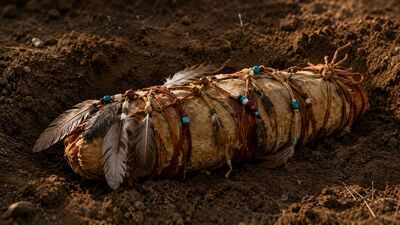
For decades, a small piece of Crazy Horse’s history may have been sitting beneath the ground in Minatare, Nebraska, with no marker to identify it. The object was not a weapon or a famous portrait of the Oglala Lakota leader. It was his medicine bundle, a private collection of sacred belongings that was treated with great care by the people who inherited responsibility for it. The bundle was eventually buried about six feet underground in 1942, when the Second World War made its owners uncertain about what lay ahead. Years later, the family returned to find that Minatare had changed so much that the hiding place could no longer be identified.

Why Crazy Horse entrusted his medicine bundle to Fast Thunder before 1877

The story begins shortly before Crazy Horse died in 1877. According to historian Thomas Powers, the Oglala leader entrusted his medicine bundle to his close friend Fast Thunder. After Crazy Horse was killed, Fast Thunder carried the bundle to the newly established Pine Ridge Reservation, where it remained within the family rather than becoming a public relic. Fast Thunder died in 1914. His wife, Jennie Wounded Horse, continued to protect the bundle and eventually placed it in the care of Nellie Ghost Dog. From there it passed to Theodore Means, Fast Thunder’s grandson. The chain of custody stretched across roughly six and a half decades, with the bundle remaining a private possession rather than something displayed or discussed openly. Medicine bundles are packages containing items considered sacred by their owners, potentially including stones, herbs, beads or hair.That privacy matters to the story. The bundle was not simply an old object associated with a famous historical figure. It had been entrusted to particular people, and its meaning was tied to Lakota traditions and family responsibility.

How Theodore Means hid the Crazy Horse medicine bundle six feet underground

During the 1930s, Oglala Lakota workers travelled from Pine Ridge to the North Platte Valley for seasonal agricultural jobs. Theodore Means was among those who found work in Minatare, where people came to pick potatoes. Then the Second World War changed the circumstances around the annual migration.In the autumn of 1942, Means decided the bundle needed to be hidden. He buried it in Minatare, roughly six feet below the ground, intending to protect it while he was away. The following year, he joined the army and went to war. The location was remembered using the landscape around it. A large cottonwood tree served as an important landmark. That might have seemed sufficient at the time. But the people who buried the bundle could not have known how dramatically the area would change over the following decades.The Nebraska History records the later account of the burial and the family’s attempt to recover it. The original Nebraska History article, “The Crazy Horse Medicine Bundle”, was written by Thomas Powers and appeared in volume 95 of the publication in 2014.

How changes in Minatare made the Crazy Horse medicine bundle impossible to locate

Theodore Means died in the early 1960s. Several years later, in 1968 or 1969, his wife Theresa returned to Minatare to search for the place where the bundle had been buried. It was no longer the same landscape. According to the Nebraska State Historical Society, many of the enormous cottonwood trees had been removed. Roads had also changed as cars became more common, altering parts of the town and its surroundings. The landmarks that had once made the burial place recognisable were gone, leaving Theresa unable to determine exactly where the bundle had been placed. That is how a possession that had been carefully handed down from one person to another became lost.There is no known modern marker identifying the spot. History Nebraska describes the bundle as being “six feet deep somewhere in Minatare, Nebraska”, making the location an unresolved part of the story rather than a confirmed archaeological site.

Why the family never identified the contents of the Crazy Horse medicine bundle

The contents were never properly identified. That uncertainty is one of the most striking parts of the story. A medicine bundle could contain objects regarded as sacred or powerful by its owner. But what Crazy Horse himself placed inside his bundle is not established by the surviving account. The family apparently did not recover the contents before the bundle was buried again. Powers’s account adds a more unusual detail. According to the family story, when the bundle was opened before burial, those present heard a sudden disturbance of owls outside the tent. In Lakota tradition, owls could be understood as warnings associated with death. The family became frightened and stopped opening the bundle, wrapping it again before putting it into the ground.That episode belongs to an oral family account rather than something that can be independently verified as an event. It is therefore best understood as part of the story preserved by the family, not as evidence that the bundle contained any particular object. The official Nebraska History account itself ends with the uncertainty. It says that the bundle may have remained a mystery by design and quotes Powers describing the lost bundle as a division “between the things that are lost and the things that survive.

How Crazy Horse’s lost medicine bundle differs from the famous Crazy Horse Memorial

The lost bundle is sometimes easily confused with the much larger public story surrounding Crazy Horse’s name in the Black Hills of South Dakota. The Crazy Horse Memorial, begun in 1948, is an enormous mountainside sculpture honouring the Lakota leader. Its origins go back to Lakota elder Henry Standing Bear, who approached sculptor Korczak Ziolkowski with the idea of creating a monument to Native American leaders. The project remains unfinished. A separate source discussing the memorial notes that the planned carving is intended to become one of the largest sculptures in the world. But the two stories point in almost opposite directions. The memorial is a public representation of Crazy Horse, while the medicine bundle was kept private and passed quietly through family hands.That distinction is important because Crazy Horse himself has long been associated with an absence of confirmed photographic portraits. The separate account supplied for this article notes that he avoided photographers and that the location of his burial was also kept undisclosed. The medicine bundle fits into that broader pattern of an individual whose history contains deliberate silences. A public monument can preserve a name and an image. A hidden bundle preserves something else: an object that was never intended to become a public display.
Source link

Ireland’s white-tailed eagles went extinct due to human persecution, now the country has released 245 chicks in the wild about 100 years later


Ireland's white-tailed eagles went extinct due to human persecution, now the country has released 245 chicks in the wild about 100 years later

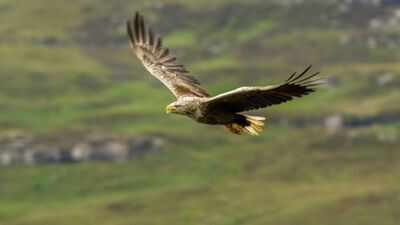
Once extinct in Ireland after decades of human persecution, the magnificent white-tailed eagle is soaring across the country’s skies again. Since 2007, Ireland has released 245 young eagles as part of a long-running reintroduction programme, and the population is now breeding and expanding on its own.In July 2026, a pair of white-tailed sea eagles successfully bred at Killarney’s Lough Léin for the fifth consecutive year, with two young birds fledging the nest. The National Parks and Wildlife Service estimates that around 150 white-tailed eagles now live in the wild in Ireland, with 17 known breeding pairs.

A bird lost to persecution

The white-tailed eagle was once a native part of Ireland’s landscape, but human persecution drove the species to extinction on the island during the 19th century. The birds were targeted because they were regarded as threats to expanding livestock, while shooting and poisoning contributed to their complete disappearance by 1912.More than a century later, conservationists decided to bring the species back. In 2007, Ireland’s National Parks and Wildlife Service, working with the Norwegian Institute for Nature Research and the Golden Eagle Trust, began the first phase of a white-tailed eagle reintroduction programme. Between 2007 and 2011, 100 young eagles from Norway were released at Killarney National Park in County Kerry.The birds gradually dispersed across Ireland. In 2012, the first successful breeding in more than a century took place at Lough Derg in County Clare. By 2020, eight to 10 breeding pairs had already fledged 31 chicks across Cork, Kerry, Clare, Galway and Tipperary.

A second push to secure the population

Despite those early successes, the population remained vulnerable. Avian influenza, extreme weather and illegal poisoning were among the threats that could undermine the recovery.In 2020, NPWS launched a second phase of the reintroduction project to strengthen the population. Young eagles aged seven to 10 weeks were brought from Norway, raised in secure facilities in Ireland and released once they were ready to fly. The birds were fitted with satellite tags so conservationists could follow their movements and survival.The programme continued until 2025. In its final year, 26 chicks were released, bringing the total number of white-tailed eagle chicks reintroduced to Ireland since 2007 to 245.The programme officially concluded in August 2025, with four chicks released at Killarney National Park. At that point, NPWS estimated that the wild population had reached roughly 150 birds, considered sufficient to maintain a self-sustaining population. But the end of the release programme does not mean the end of conservation work.

Eagles are now breeding on their own

The strongest sign of success is that Irish-born eagles are now reproducing in the wild. In July 2026, two young white-tailed eagles fledged from a nest at Lough Léin in Killarney, marking the fifth consecutive year that the pair had successfully bred. There are now 17 known breeding pairs across Ireland, although the exact number of chicks born in the wild in 2026 is not yet known.Moreover, the Fota Wildlife Park in County Cork announced the successful birth and fledging of a white-tailed sea eagle chick—the first chick of the species born at the park in more than a decade, as per a report by Good News Network. The eaglet hatched on April 13 to resident parents Áine and Tony, who, according to their caretakers, have taken naturally to the demanding job of raising Europe’s largest eagle.“The mother and father have done a great job,” said Jess Hodnett, Fota Wildlife Park’s Native Species Conservation Officer.The first successful breeding in modern times was recorded in 2012. Since then, the birds have established themselves in several parts of the country, including Cork, Kerry, Clare, Galway, Tipperary and Donegal.The recovery has also changed attitudes. The programme involved working with farmers and local communities in areas where the eagles were released and eventually settled. NPWS says cooperation with landowners has been an important part of the effort to ensure the birds and farming communities can coexist.

Ireland’s giant bird of prey

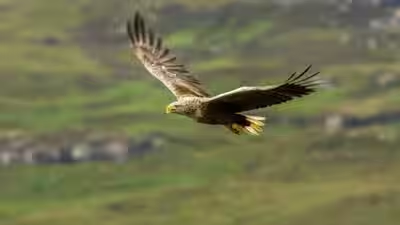
The white-tailed eagle (Haliaeetus albicilla), also known as the white-tailed sea eagle, is one of Europe’s largest birds of prey. Adults can have a wingspan of around 2.5 metres.Their diet is varied. They primarily eat fish but can also take waterbirds, rabbits and hares, while carrion forms an important part of their diet, particularly during winter. They generally build territories around coastlines and large freshwater lakes.The species is also a long-lived, slow-breeding bird. Females typically lay one to three eggs in late March or early April, with incubation lasting roughly 38 to 40 days. Chicks usually fledge after around 10 to 12 weeks and remain dependent on their parents for several more weeks.

The comeback is not without risks

Although Ireland’s population is now considered self-sustaining, the eagles remain vulnerable. Illegal poisoning and shooting continue to threaten the recovery. In 2025, an investigation followed the suspected poisoning of Caimin, one of Ireland’s oldest breeding white-tailed eagles, which had held territory at Lough Derg for 17 years. Another reintroduced eagle was confirmed to have been shot near Lough Owel in County Westmeath that same year.NPWS says illegal poisoning remains one of the biggest threats to the population. Avian influenza, adverse weather, lead poisoning and collisions with wind turbines have also contributed to eagle deaths.For now, however, the sight of young white-tailed eagles leaving nests in Killarney represents something that seemed impossible a few decades ago: a species once wiped out in Ireland is once again raising its young in the wild.


Source link

‘Premeditated and gruesome assault’: Delhi high court denies bail to Olympic medalist Sushil Kumar in murder case | Off the field News


'Premeditated and gruesome assault': Delhi high court denies bail to Olympic medalist Sushil Kumar in murder case

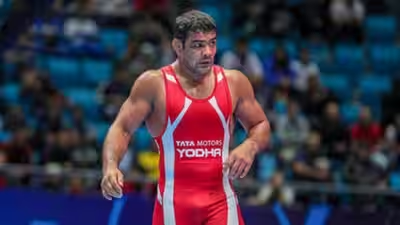
The Delhi high court has refused to grant bail to Olympic wrestler Sushil Kumar in the alleged murder of former junior national wrestling champion Sagar Dhankar.Justice Purushaindra Kumar dismissed Kumar’s bail plea on August 6, citing concerns about his ability to influence witnesses, his conduct before his arrest, the seriousness of the alleged offence and his ability to affect the outcome of the ongoing trial.The judge noted that while bail is generally the rule and jail the exception, the case involved a “premeditated and gruesome assault resulting in death”. The court said this was supported by the recovery of a firearm, video evidence and other material that is yet to be examined during the trial.Kumar’s counsel sought bail on the ground that circumstances had changed since his earlier bail was cancelled. The lawyer pointed out that Ashok Dhankad, Sagar’s father whose complaint had led to the earlier cancellation of bail, had not supported the prosecution’s case during the trial.The defence also argued that Kumar had already spent more than five years in custody and that only formal and official witnesses remained to be examined.Delhi Police and Dhankar’s father opposed the bail plea.The high court, however, said the defence’s claim that Sagar’s father had not supported the prosecution was disputed. It also referred to the Supreme Court’s earlier decision cancelling Kumar’s bail, in which it had noted his social standing and influence and the fact that witnesses had turned hostile whenever he was given temporary liberty.“Whether the deposition of Ashok Dhankad (deceased’s father) does or does not support the prosecution is, moreover, a matter of appreciation of evidence that must await the outcome by the trial court. It cannot be treated as a change in circumstances sufficient to unlock the door that the Supreme Court closed,” the court said.“In these circumstances, this court is not persuaded that the petitioner has made out a case either for a genuine change in circumstances within the meaning of the liberty reserved by the Supreme Court, or, independently, for the grant of regular bail,” it concluded.Kumar was arrested in May 2021. A sessions court later granted him one week’s interim bail for knee surgery on July 19, 2023.The Supreme Court cancelled his bail on August 13, 2025, setting aside a Delhi high court order. It said Kumar’s “domineering influence” over witnesses and the possibility of delaying the trial proceedings could not be ruled out.The High Court had granted Kumar bail on March 4, 2025. Earlier, on February 6, a trial court had rejected his bail plea, saying the possibility that he could influence witnesses “cannot be ruled out”.In October 2022, the trial court framed charges against Kumar under Indian Penal Code provisions relating to murder, criminal conspiracy, intimidation and rioting with a deadly weapon. Charges were also framed under the Arms Act.The trial court had said Dhankar was abducted and taken to the stadium, where he was severely assaulted by several accused persons using baseball and hockey sticks.


Source link

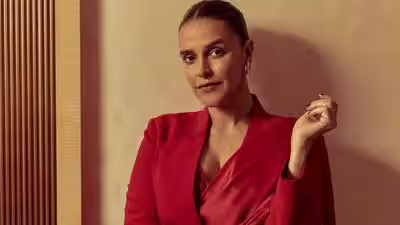
Neha Dhupia on actors travelling with big entourages are ‘stifling’, explains why she prefers a small team on set: ‘An actor’s talent isn’t defined by the number of people’ |


Neha Dhupia on actors travelling with big entourages are ‘stifling’, explains why she prefers a small team on set: ‘An actor’s talent isn’t defined by the number of people’

Neha Dhupia has built a career that has consistently defied conventional expectations. Over more than two decades in the Hindi film industry, the actor has moved across genres and mediums rather than following the traditional trajectory often associated with actresses starting out. In an interview recently, Dhupia reflected on her unconventional career path, the opportunities she received, the changing culture of film sets and her views on actors travelling with large entourages.

Neha Dhupia on carving her own path in Bollywood

Reflecting on this journey in a conversation with Bollywood Hungama, Neha said, “It was not really unique. Maybe back then it was aspirational, but I didn’t have those many opportunities. If you look at it in reverse, it was like carving your own path. My mum always says, ‘Jo hota hai, acche ke liye hota hai’. There’s always a reason for it. What that reason is, where you’re going with it, what’s going to happen, no one knows. Maybe, 20 years later, now I feel I did the right thing because you are paying that compliment to me. Back then, I was not so calculative in my 20s.”Speaking about her long journey in the industry, Neha expressed deep gratitude for everything it has given her over the years. She said, “I feel like my entire life has been about playing the waiting game. I am doing the same with this one as well. You are always hoping that something interesting happens. The only thing I wish for now, in the real world, is that every job I do leads me to another interesting job and an interesting set of people – sometimes the same ones and sometimes different ones. But there’s no other place I want to be. I have no regrets and no anger. I never say, ‘Yeh industry ne mujhe yeh nahin diya ya woh nahin diya.’ Industry ne mujhe sab diya hai. It gave me a face, it gave me a voice, it gave me a name, it made me a brand. It made me public, it domesticated me – all of it. And I just love it. There’s no business like show business!”

Neha Dhupia calls big entourages ‘very stifling’

When Neha Dhupia started out 23 years ago, vanity vans had only just become commonplace, while the term “entourage” was virtually unheard of. Asked for her views on the ongoing debate around actors travelling with large entourages, Neha shared a firm stance rooted in her own experience. She said, “We did have vanity vans even then, but we didn’t have big entourages. I find big entourages very stifling. And my views stay the same. I have always managed with a small entourage. I don’t think an actor’s ability or talent is defined by the number of people he or she travels with or arrives on a set with. In fact, the more you declutter yourself, the better your ability to perform.”

More about Neha Dhupia starrer ’52 Blue’

Directed by acclaimed Egyptian filmmaker Ali El Arabi, 52 Blue is an international coming-of-age drama that follows Ashish (Yadav Shashidhar), a lonely young man from Kerala who leaves home in pursuit of his dream of meeting his idol, Lionel Messi, during the 2022 FIFA World Cup in Qatar. The film marks Neha Dhupia’s international debut, with Adil Hussain also starring as Ashish’s devoted parent. Combining real footage from the Qatar World Cup with a heartfelt fictional narrative, the film explores themes of migrant labour, parental love and self-discovery.


Source link

Nasa invites Isro to join Moon base programme | India News


Nasa invites Isro to join Moon base programme

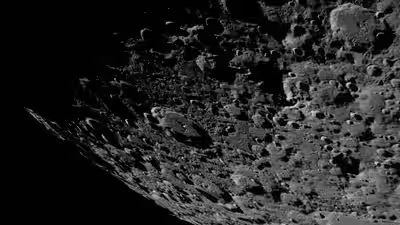
BENGALURU: Nasa has invited Isro to join its Moon Base programme, opening a new avenue for India-US cooperation in lunar exploration and human spaceflight.The Moon Base was announced during Nasa’s “Ignition” event on March 24, 2026, where the US space agency unveiled a series of initiatives designed to achieve President Donald J Trump’s National Space Policy and advance American leadership in space.The invitation to Isro was extended during the 9th meeting of the India-US Civil Space Joint Working Group (CSJWG), held at Isro headquarters in Bengaluru on Aug 5 and Aug 6.The meeting brought together senior officials from both countries to advance civil and commercial space cooperation under the US-India Transforming the Relationship Utilising Strategic Technology (TRUST) Initiative.The invitation builds on the growing partnership between the two countries under the Artemis Accords, which seek to establish principles for the peaceful and sustainable exploration of the Moon and beyond.“Nasa invited Isro to join its Moon Base program, building on the two countries’ partnership under the Artemis Accords. The two sides also agreed to advance discussions for cooperation on open scientific data sharing under the [Artemis] Accords,” the US Embassy said in a statement on Tuesday.The two sides discussed expanding collaboration in future space science and human spaceflight technologies. The meeting came after the successful launch of Nisar, the joint Nasa-Isro Synthetic Aperture Radar mission, last year. Nisar is designed to provide detailed observations of changes on Earth’s land and ice surfaces and is the first satellite mission to use two different radar frequencies to study the planet.The two countries also “reaffirmed their commitment to advancing guidelines on the long-term sustainability of outer space activities through the UN Committee on the Peaceful Uses of Outer Space (COPUOS),” the statement read, adding that the teams reviewed ongoing multilateral efforts aimed at strengthening the committee’s effectiveness.The CSJWG meeting was addressed by Department of Space secretary V Narayanan and US ambassador to India Sergio Gor. It was co-chaired by M Sankaran, director of Isro’s UR Rao Satellite Centre, and US officials Wesley Brooks, assistant secretary of state for oceans and international environmental and scientific affairs, and Kathleen Karika, Nasa associate administrator for international and interagency relations.

Share your thoughts in the comments